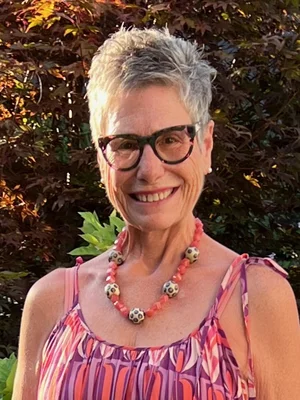
Of Mice and Men
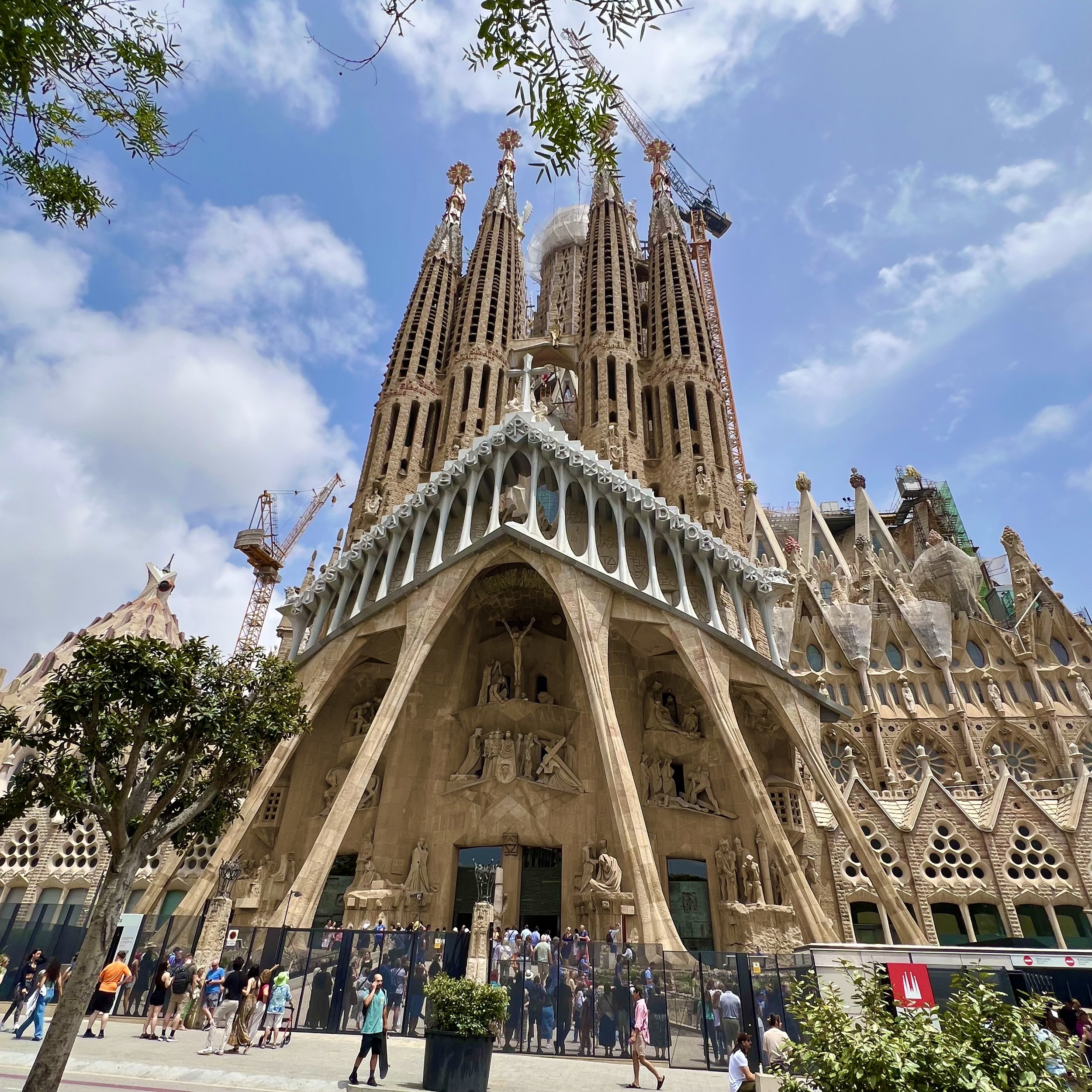
La Sagrada Familía, Barcelona
It’s a well-established fact that my husband has a history of risk taking. For those new to this blog, a reading of “Daredevils and Dreamers” (March 2026 blog) will suffice. While venturesome behavior can offer momentary adrenaline rushes and the thrill of achievement, its risks can sometimes result in physical pain, upheaval, and disruption of everyday life. We certainly experienced a hefty dose of that this summer.
For the first time since retiring to France, we chose not to spend July at the University of Pau in hot, unairconditioned classrooms cramming our stiff old brains with French grammar. This decision left us free to travel and commemorate my milestone birthday in style. The plan was a long-awaited trip to the Dordogne. I spent weeks reading about the region, selecting a handful of “beaux villages” to visit and, most importantly, deciding where to celebrate “Bastille Day,” which serendipitously coincides with my birthday.
Grace J. Silla’s travel and food blog inspired the plan for my special day on July 14th. Her description of the national holiday in Saint Cirq Lapopie sounded just like the kind of magic I was looking for. It would be quite different from the “grander,” more urban Pau experience we’ve enjoyed for many years. She promised that in addition to low key fireworks “you can watch the story of Bastille Day unfold from the beautiful mournful music that’s played to the torches that are lit on the hill to the streams of light going off at the church, all holding a special meaning in the hearts of the French people. I can’t put into words how memorable that moment was . . .”
https://www.fashionedible.com/southwest-france-guide-5-charming-towns/
However, prior to our trip, JB had to squeeze in at least one jump to maintain his Class A skydiving license. His plan was a brief, four-day junket to Barcelona: two days of jumping sandwiched between two days of travel. It’s a drivable route, albeit a long one, over the Pyrenees Mountains. I chose to stay home and spend time refining the Dordogne getaway and enjoying an evening with my friend Isabelle.
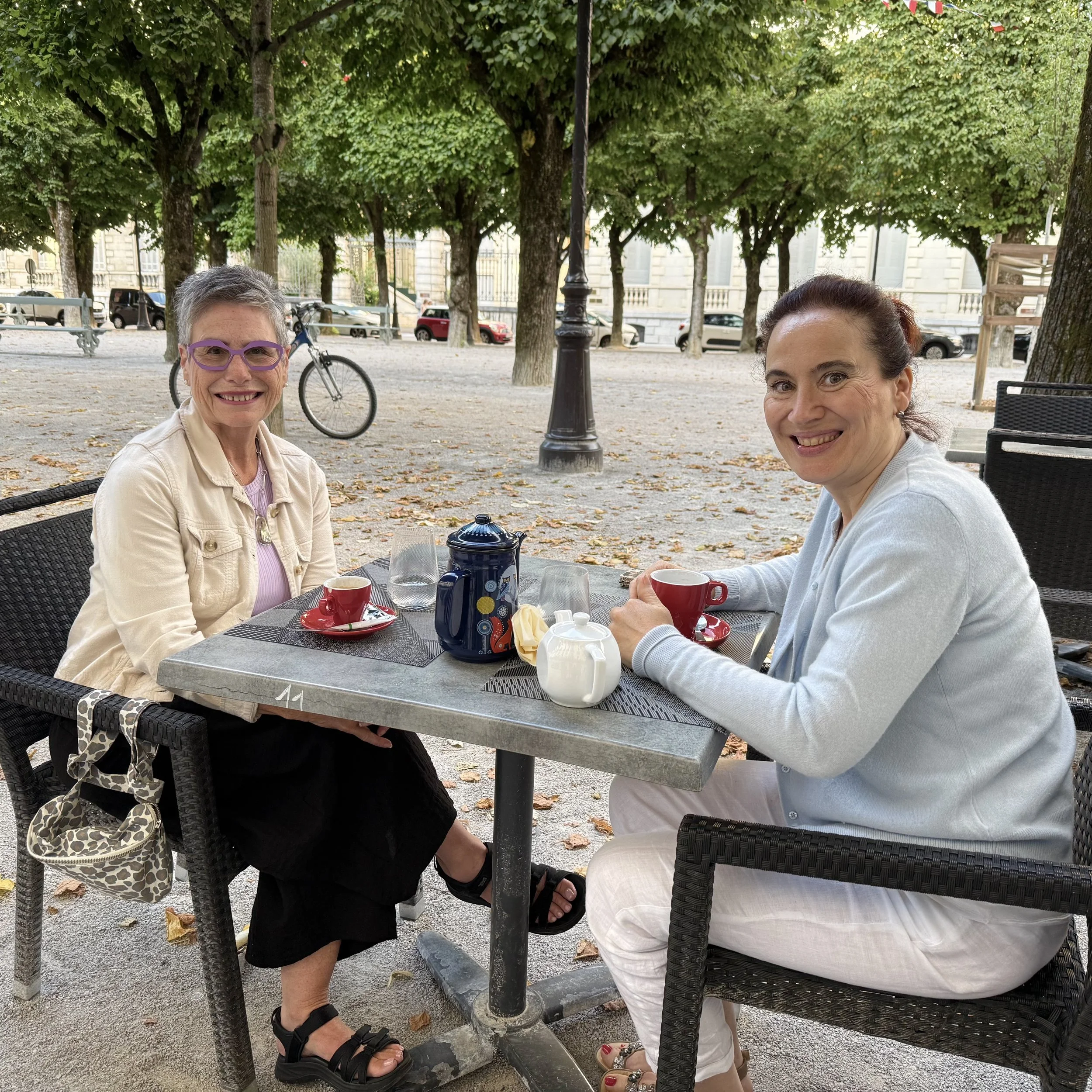
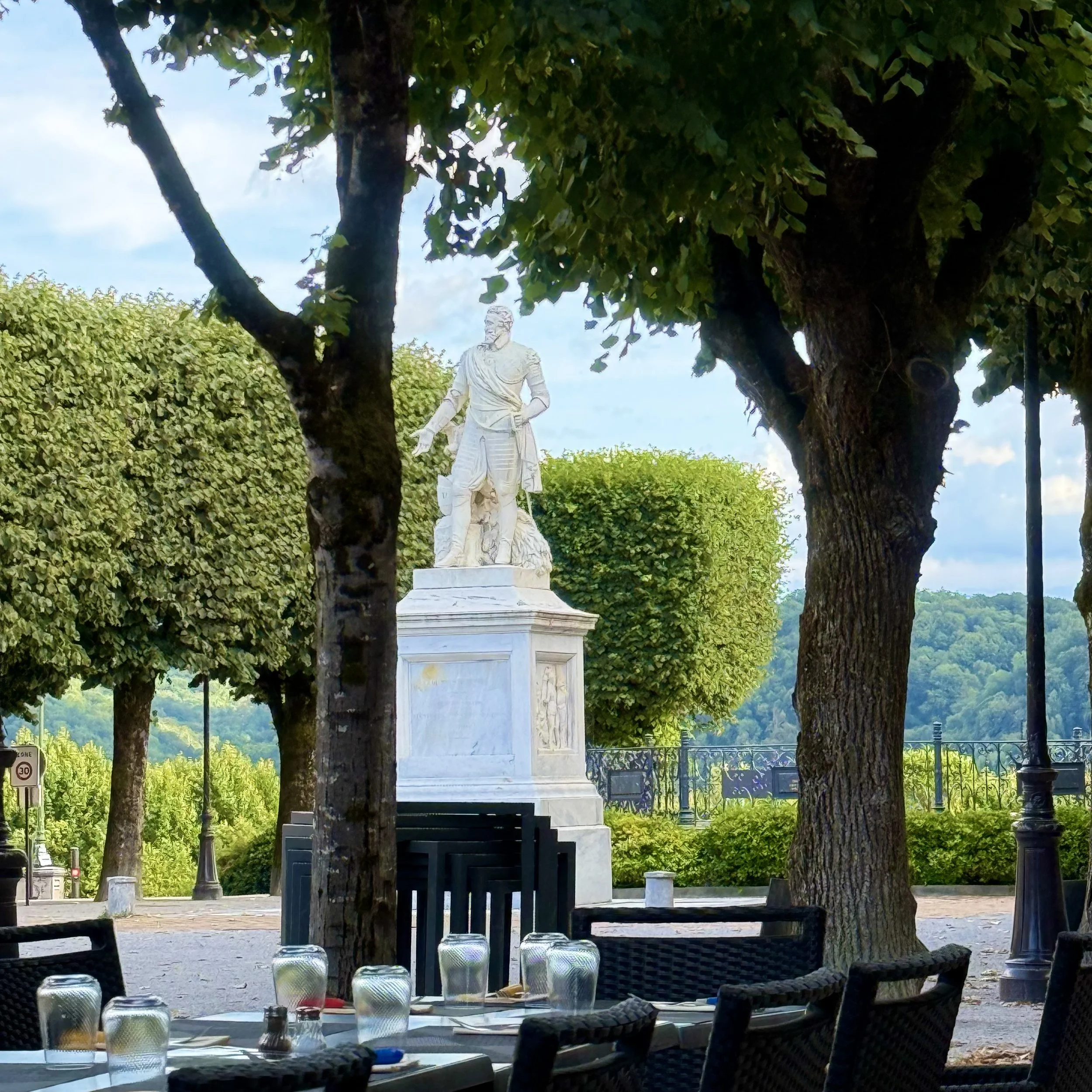
Dinner with Isabelle on Place Royale. Calm before the storm . . .
Yes, there is a big “but” coming. As Scottish poet Robert Burns so wisely quipped, “The best laid plans of mice and men often go awry.” JB’s first day of jumping, began with a bad omen. His early Thursday morning text was, “My day got off to a bad start. I think I left my debit card in the garage pay machine…” followed by a more positive note an hour later, “First jump done, went pretty well, landed on feet. One more today.” Two hours later, I received the jarring message, “Bad news—had a hard parachute open, separated my shoulder, getting it treated. I did land fine after it happened. No more jumps for a few weeks.”
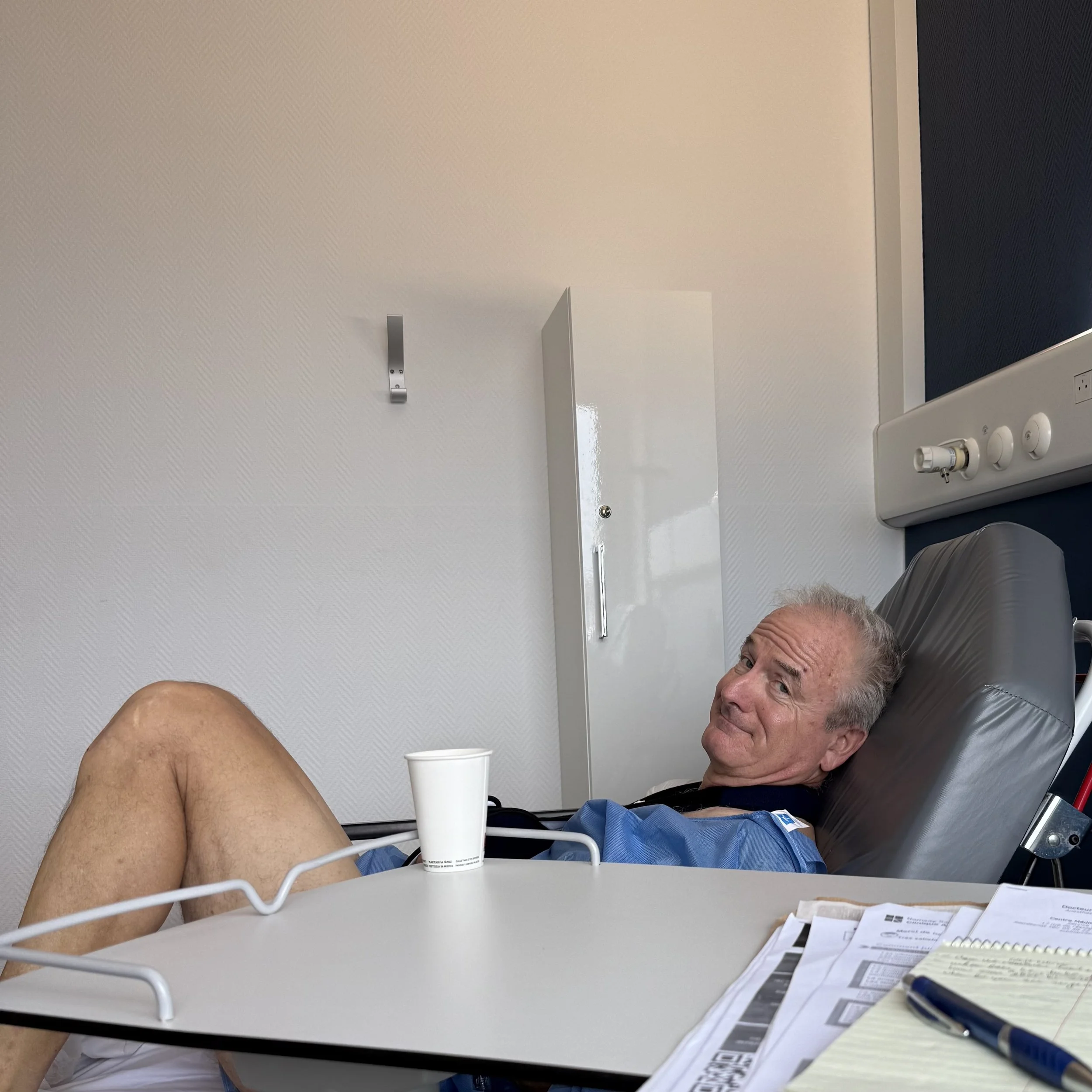
Clearly this was a man in a state of optimistic shock. He was taken by ambulance to a nearby hospital where x-rays indicated his upper right humerus was broken completely in half and would require surgery (back in France). JB returned to his hotel late that night with his shoulder in a stabilizing brace, his arm in a sling, and a prescription for serious pain pills in his only functional hand.
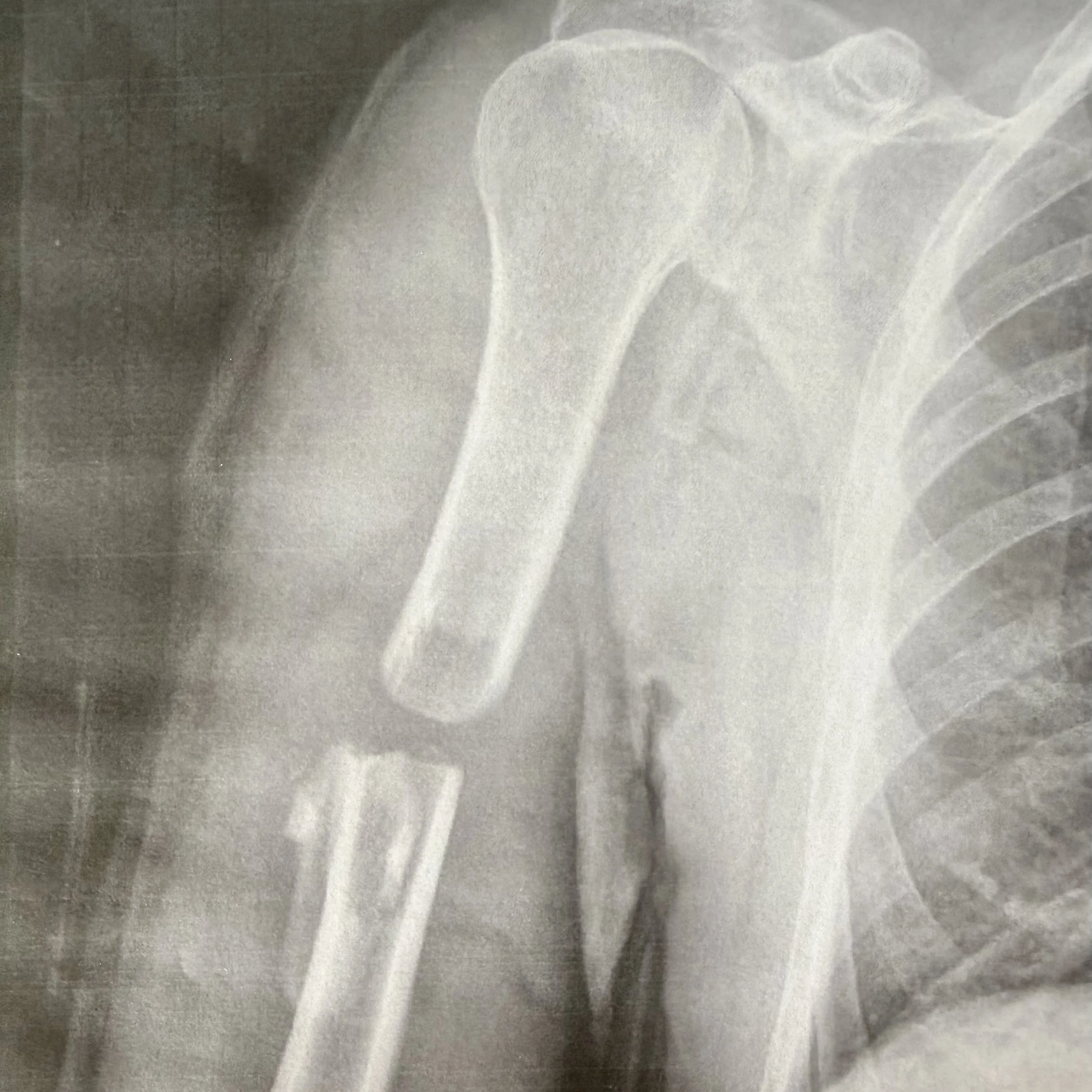

Barcelona ER: reality setting in . . .
Meanwhile, I launched a rescue mission by air and land. First, I miraculously snagged the last seat available on a flight the following morning from Pau to Paris, and then Paris to Barcelona (there are no direct routes). Next, I called Christi, our long-time translator and friend, to employ her formidable logistics skills (honed during US military service). She reconned the best hospital and surgeon for JB’s operation (in coastal Biarritz rather than Pau) and determined that waiting for a scheduled operation could be circumvented by going through urgent care once again, in France. The drive from Barcelona to Biarritz would, unfortunately, take two days versus JB’s original one day trip from Pau. However, I was immediately on board with this ground campaign as it avoided driving tricky mountain roads. While planning JB’s extraction, I played emotional ping-pong—feeling grateful he was alive and wanting to “do him in” myself . . .

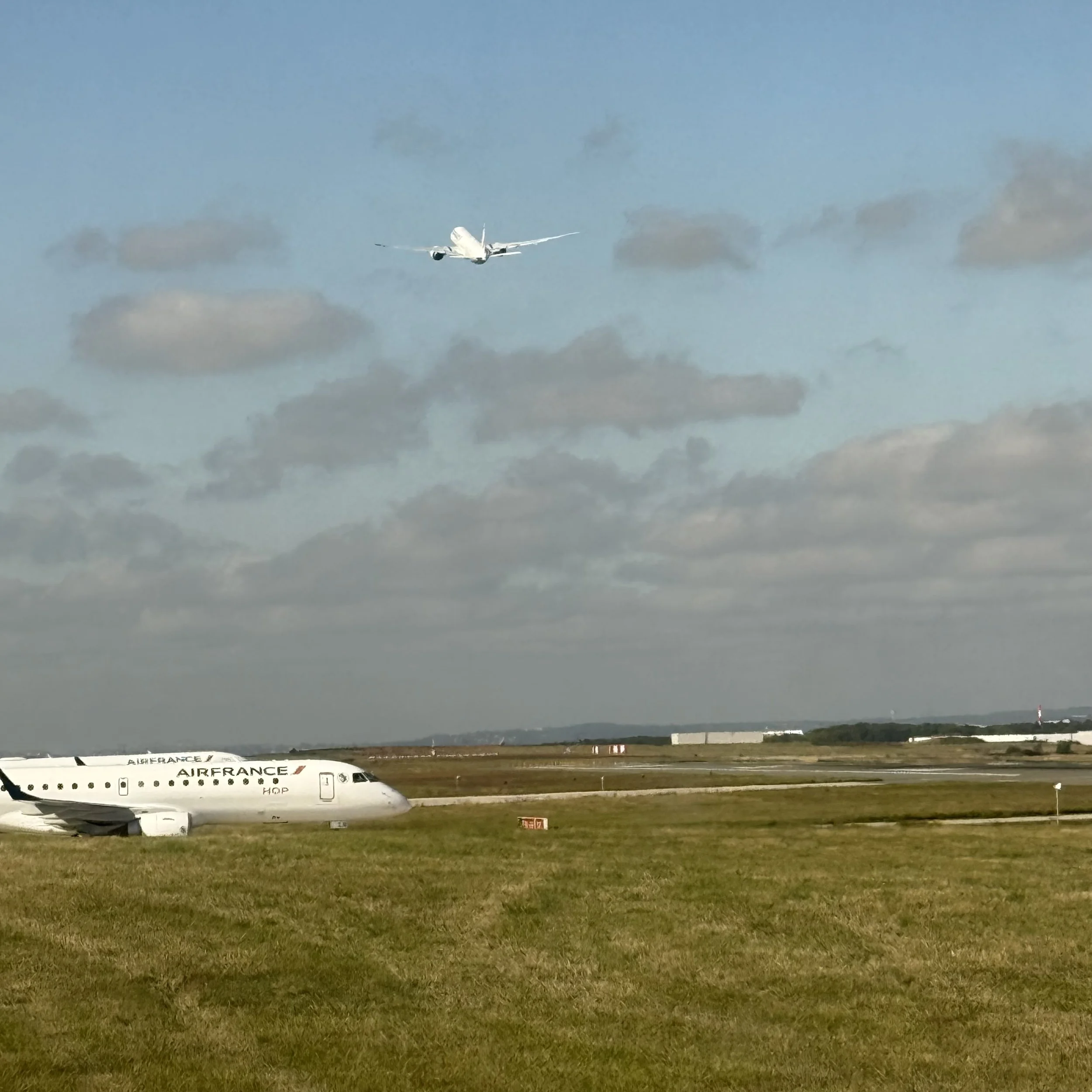
Rescue Phase 1 . . .
I arrived in Barcelona, just in time for peak Friday traffic on the day before the city would host the inaugural stage of the “Tour de France.” The 14-kilometer (8.5 mile) taxi ride to the hotel took over an hour. On Saturday morning, an equally long taxi ride took us to the “drop zone” where our car, JB’s jump suit, and his helmet had been abandoned. Unsurprisingly, his priority was finding a qualified instructor to sign his logbook for the two jumps he had completed. Mine was getting on the road as soon as possible. After driving to our hotel in Zaragoza, the journey’s mid-point, we shared a lackluster meal (in a rare restaurant open before 8:30) and spent a restless night—me worrying about the hurdles ahead and JB in too much pain to sleep.
Early Sunday morning, we continued our final leg to the Biarritz clinic recommended by Christi. She met us at the ER to spearhead communications in French—explaining the circumstances of JB’s injury and prior emergency treatment, as well as shepherding him through another round of examinations.
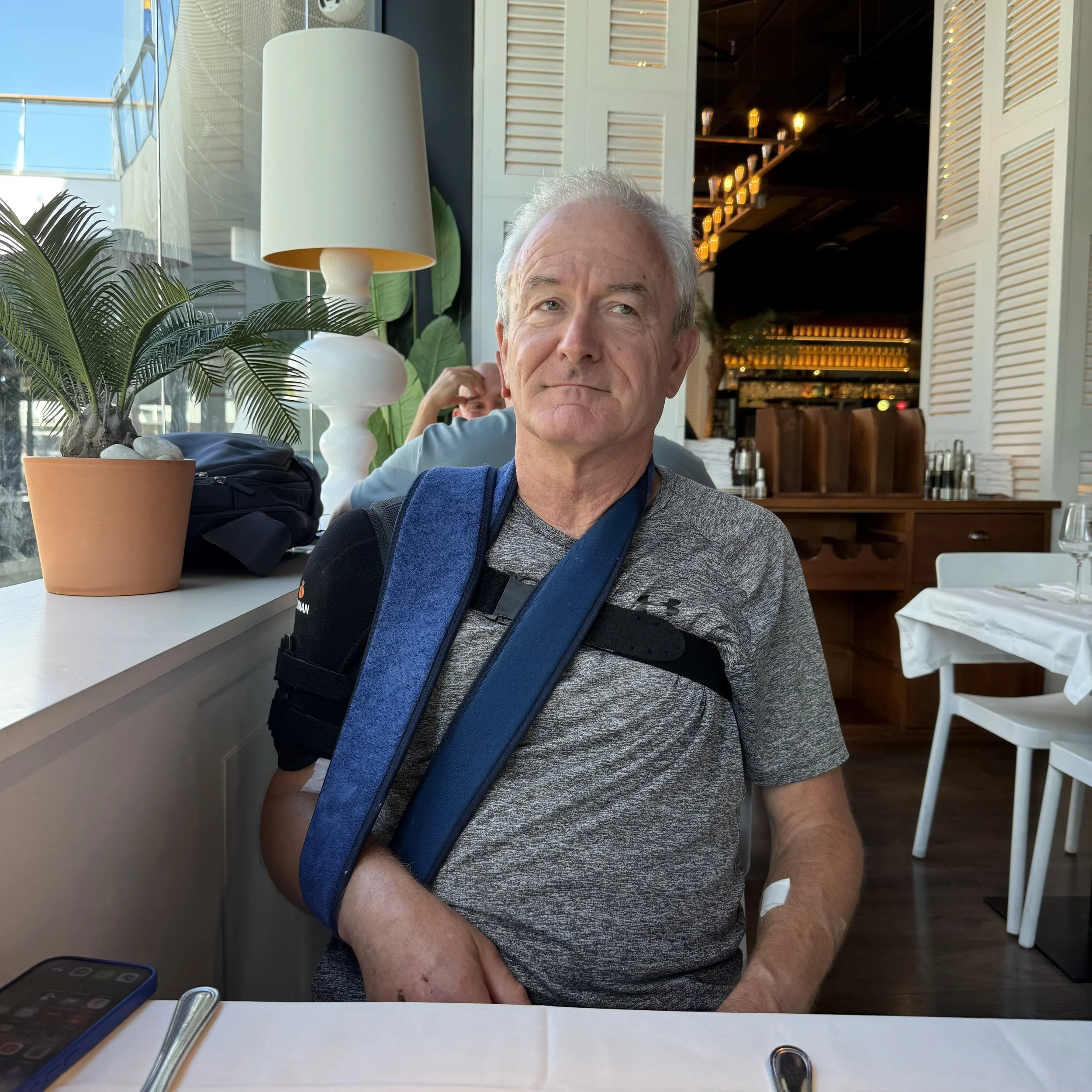

Rescue Phase 2: Dinner on Friday in Barcelona. Passing ruins of a Roman ampitheater on the way to dinner, Saturday, in Zaragoza.
A week later, auspiciously the day before my now canceled “Bastille Birthday Bash,” JB’s arm was reconstructed with enough metal and pins to set off all airport security machines hence forward. I braved the day without Christi’s interpretive assistance and deployed my entire arsenal of slowly improving French skills to answer a barrage of medical questions and to ask a myriad of my own regarding medications and aftercare. Christi remained “on call” at her nearby home—a comforting lifeline that proved unnecessary. We spent the night there in case JB encountered complications, but thankfully he had no post-surgical problems.
The next morning, we drove home and began our “new normal” for the next six weeks: wound care from a visiting nurse every other day, physical therapy three times a week, daily massages (by me) to reduce inflammation and assist healing, frequent trips to the pharmacy, and my assistance with all activities requiring two hands.
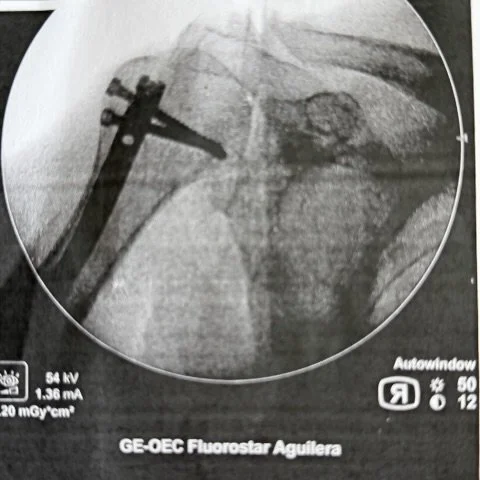
Post OP: The “hardware” and the smiling patient—before his local anesthesia wore off.

JB’s exceptional surgeon, Dr. Julien Vignes. Full of personality and warmth!
When I’ve felt exhausted or disappointed by how my summer was upended, I remind myself that it could have been worse, much worse . . . While skydiving deaths are rare, related injuries are often severe. Counterintuitively, most aren’t caused by parachute failure but by human error while landing. JB’s injury, however, occurred in mid-air. When he pulled the handle to deploy his main parachute, nothing happened. This is called a “hard pull” and is one of several high-speed malfunctions jumpers are trained for. The proper response is to try again before resorting to the emergency parachute. His second, more aggressive pull worked, but in the process the right harness strap slipped from his shoulder to his mid-upper arm. The force of the parachute opening jerked the displaced strap and broke his arm.
For a split second, JB was unaware of his injury—his brain unleashing thrill inducing adrenalin to numb pain and fear instead. When he reached up to release the pair of overhead brakes, to steer and control the speed of descent, his right arm remained motionless. His first thought was, “whose arm is this?” Reality quickly sank in. Because he had only pulled the left brake, the parachute began spiraling. Fortunately, JB is a man of calm calculation, even in a state of shock. By alternating pulls on the left and right brakes with one arm, he was able to stop spinning and to direct his trajectory.
Unfortunately, the final deceleration to land safely requires a controlled, simultaneous pull on both brakes. As this was impossible, JB mentally prepared for a Parachute Landing Fall (PLF): a brief touch down on the feet followed by rolling onto one side to disperse the energy of hitting the ground. He had the astonishing wherewithal to execute this perfectly on his uninjured side and to wait for a golf-cart rescue.
We will never be certain of what caused the grievous “hard pull.” JB suspects some stiffness in the relatively new “rig” (the rented backpack, parachute, and harness assembly) was a factor. It’s also likely that the injury might have been avoided if had he tightened the harness a bit more across his chest before jumping and regained proper body position in the air before his second pull—all matters of infinitesimal finesse contemplated in late game quarterbacking…
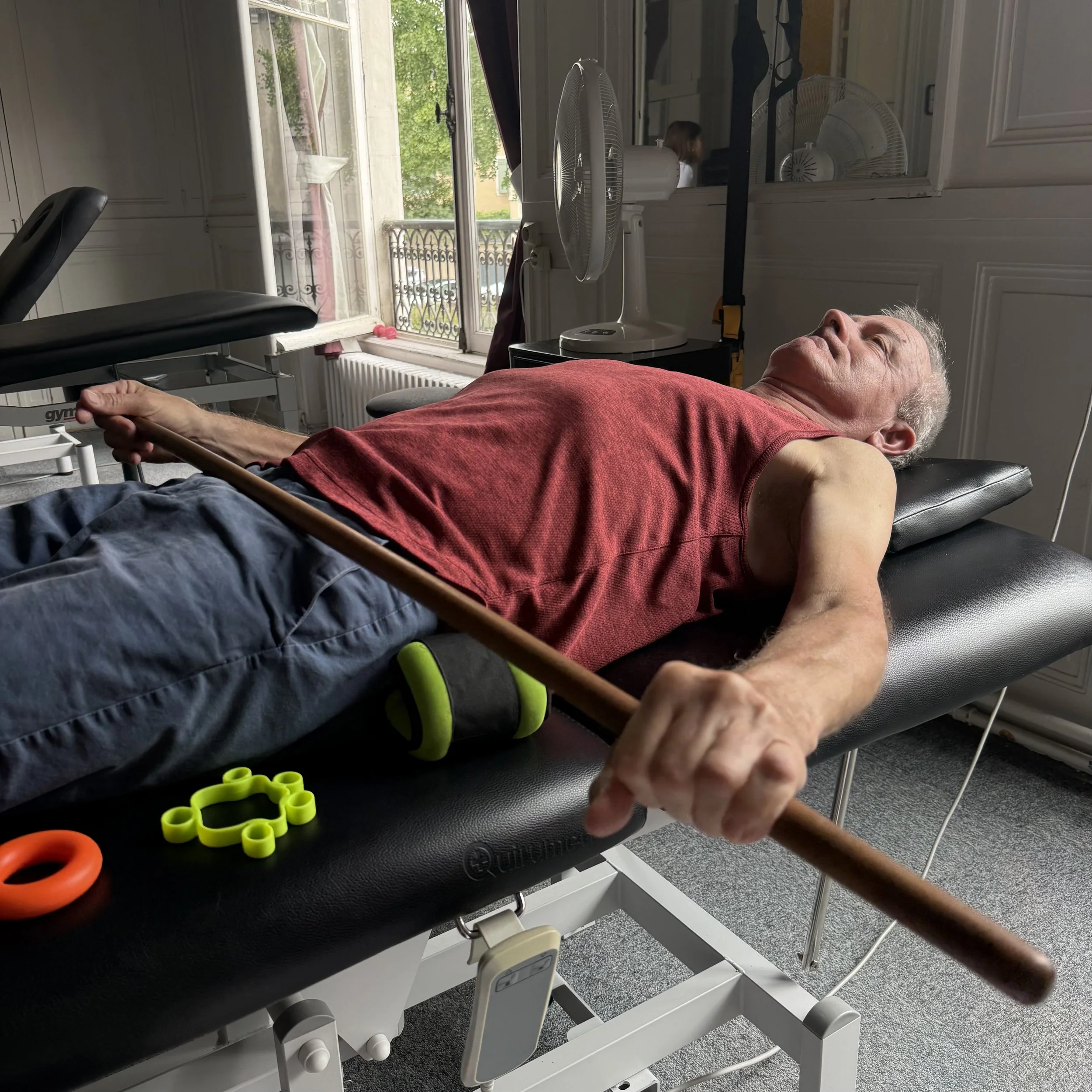
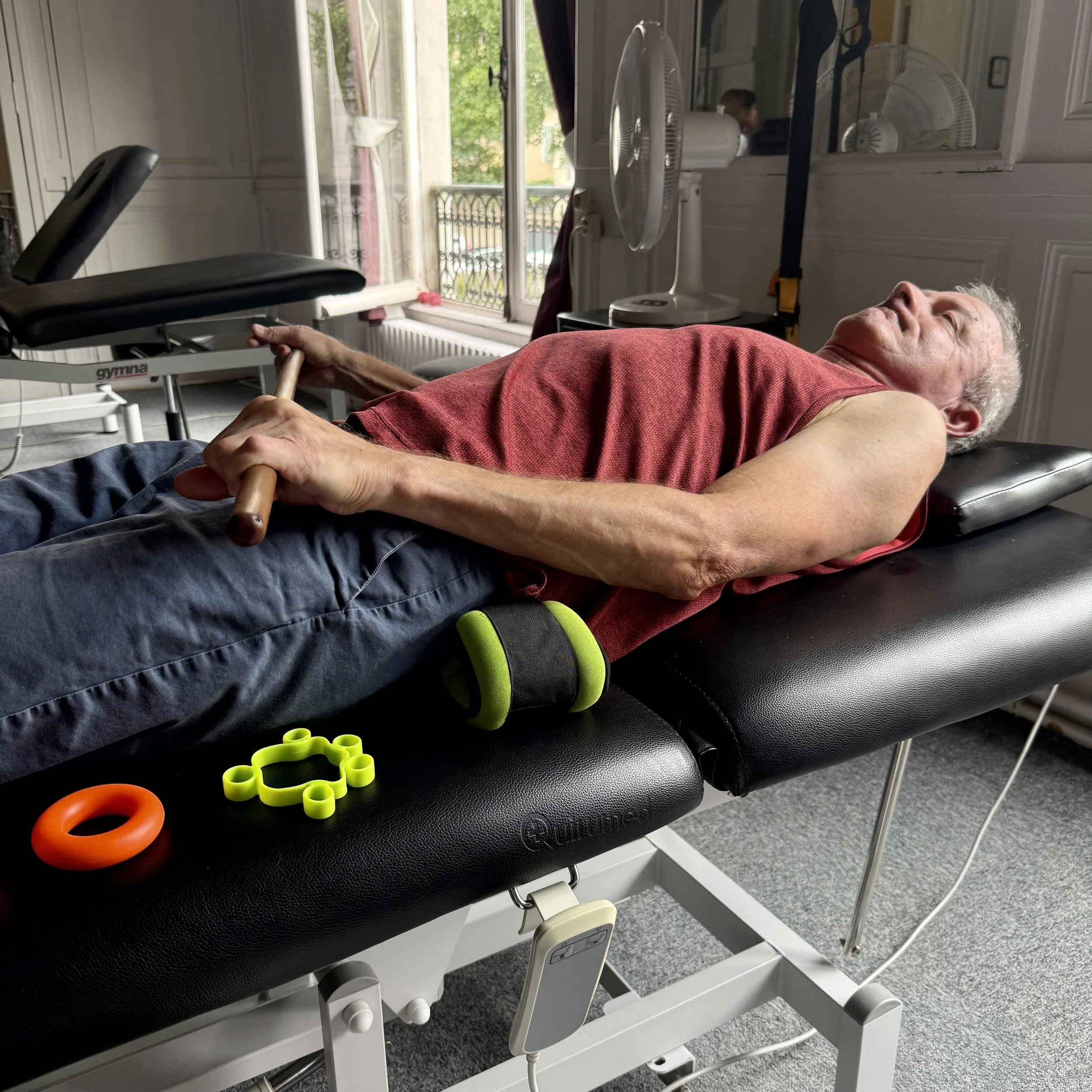
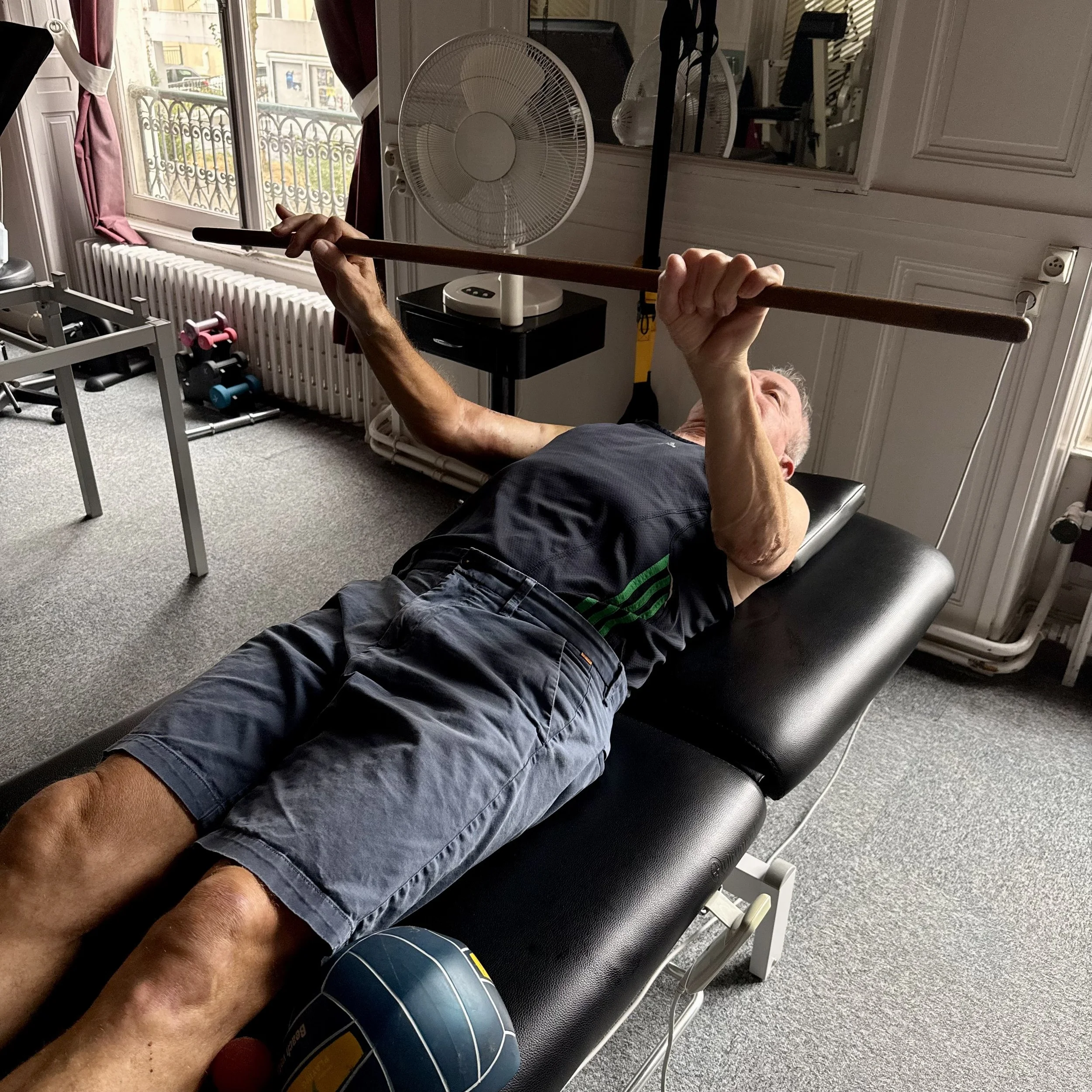
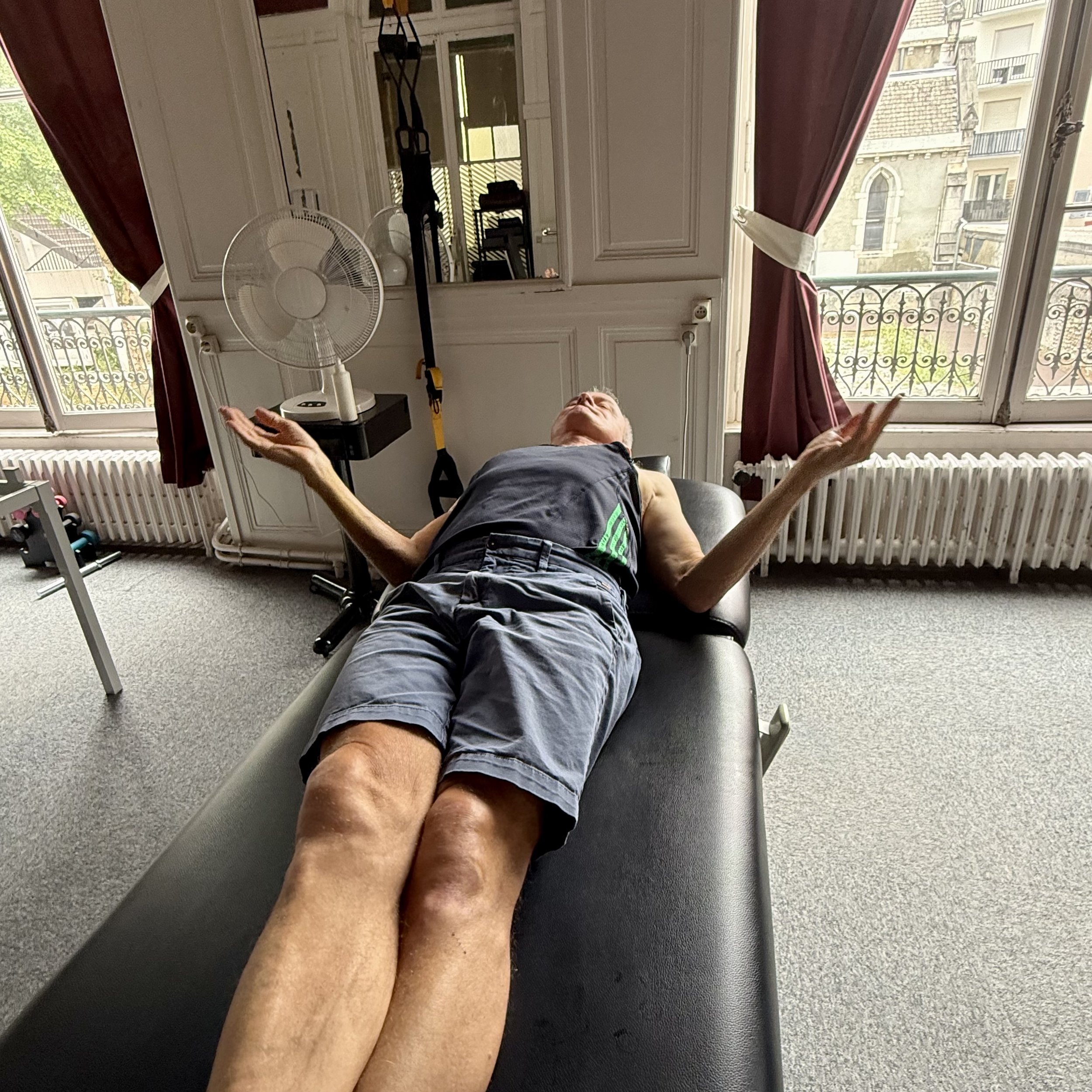
Physical Therapy Week 1: Unable to lay arm flat and barely able to lift pole or move it side to side. Week 2: Lifting pole to 45 degrees and regaining some lateral movement.
Retrospectively, the medical aftermath could also have been much worse. Despite language challenges, our first serious encounter with the French healthcare system was simpler and, dare I say, superior to what it might have been in the US. Fortuitously, we had both just qualified for national healthcare, which covered nearly all the emergency room services, consultations, radiology, surgery, and an optional, private waiting/recovery room with internet and snacks (for an additional modest fee). This “splurge” offered me a peaceful place on a stressful day and allowed me to be with JB before the operation and during his recovery prior to discharge. However, because we hadn’t yet selected supplemental health insurance (to fill minimal coverage gaps), we paid about 700 euros (~ $800.00) out of pocket for the care he received. In the US, where healthcare is profit based and insurance coverage varies wildly, our deductible alone would have been at least four times that amount!
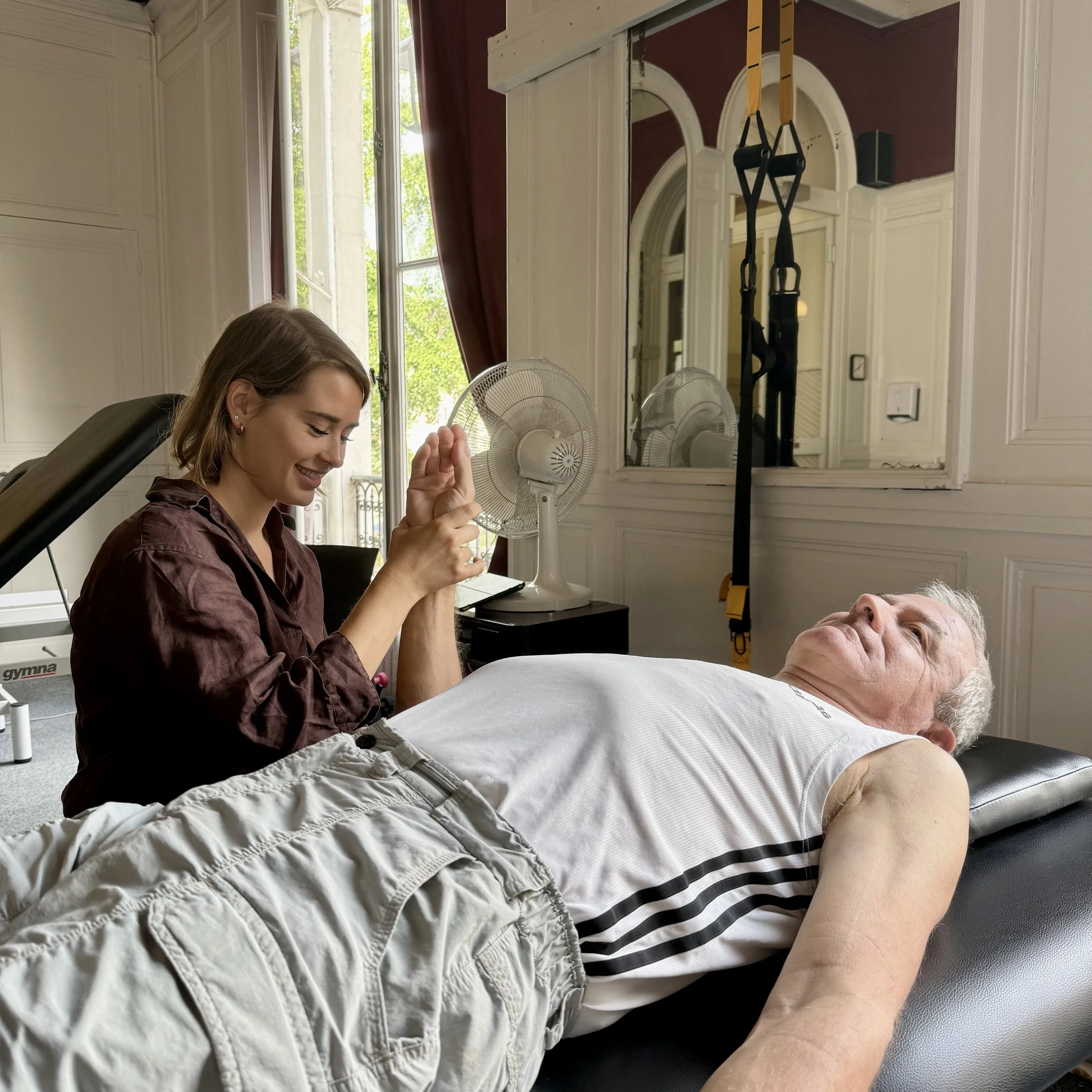

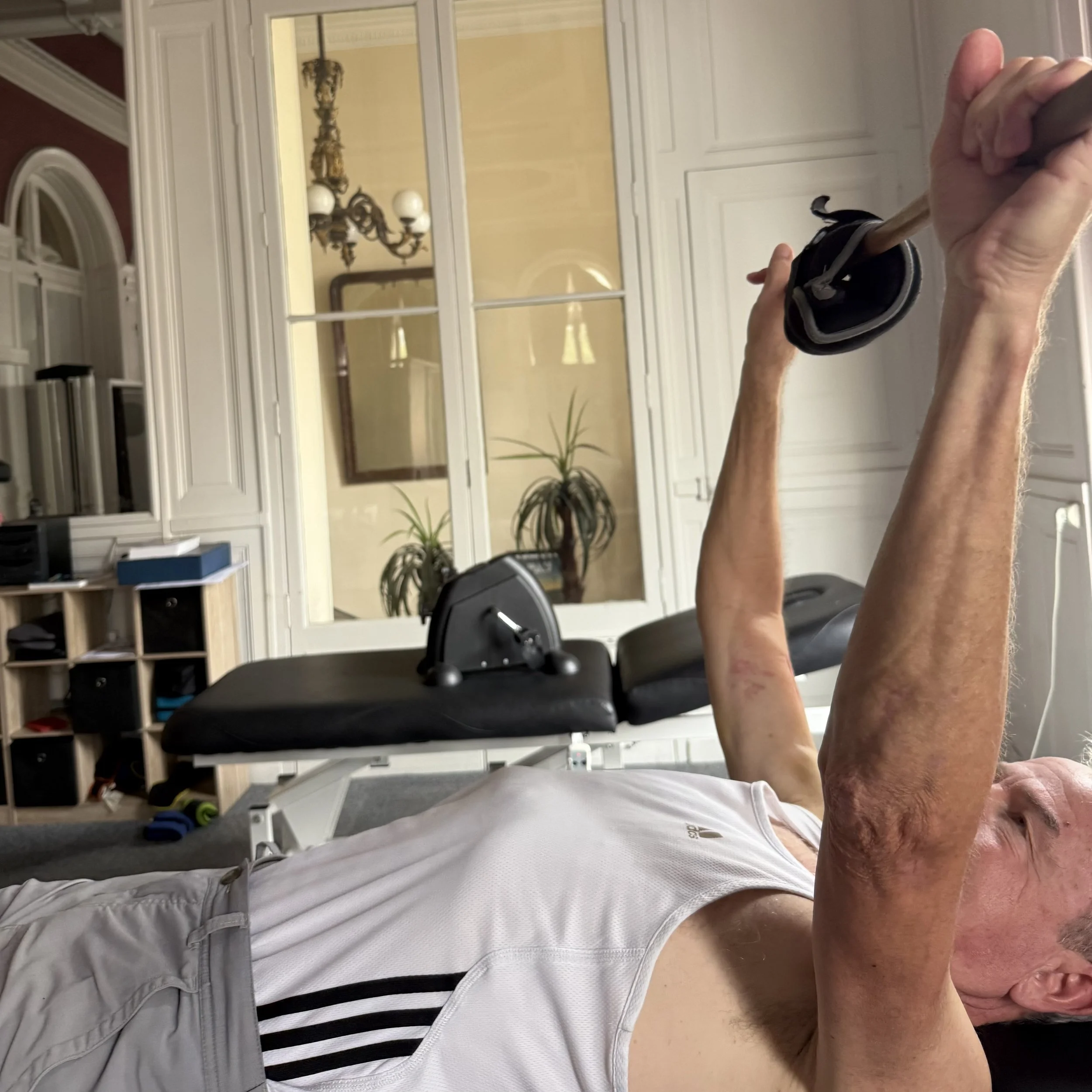
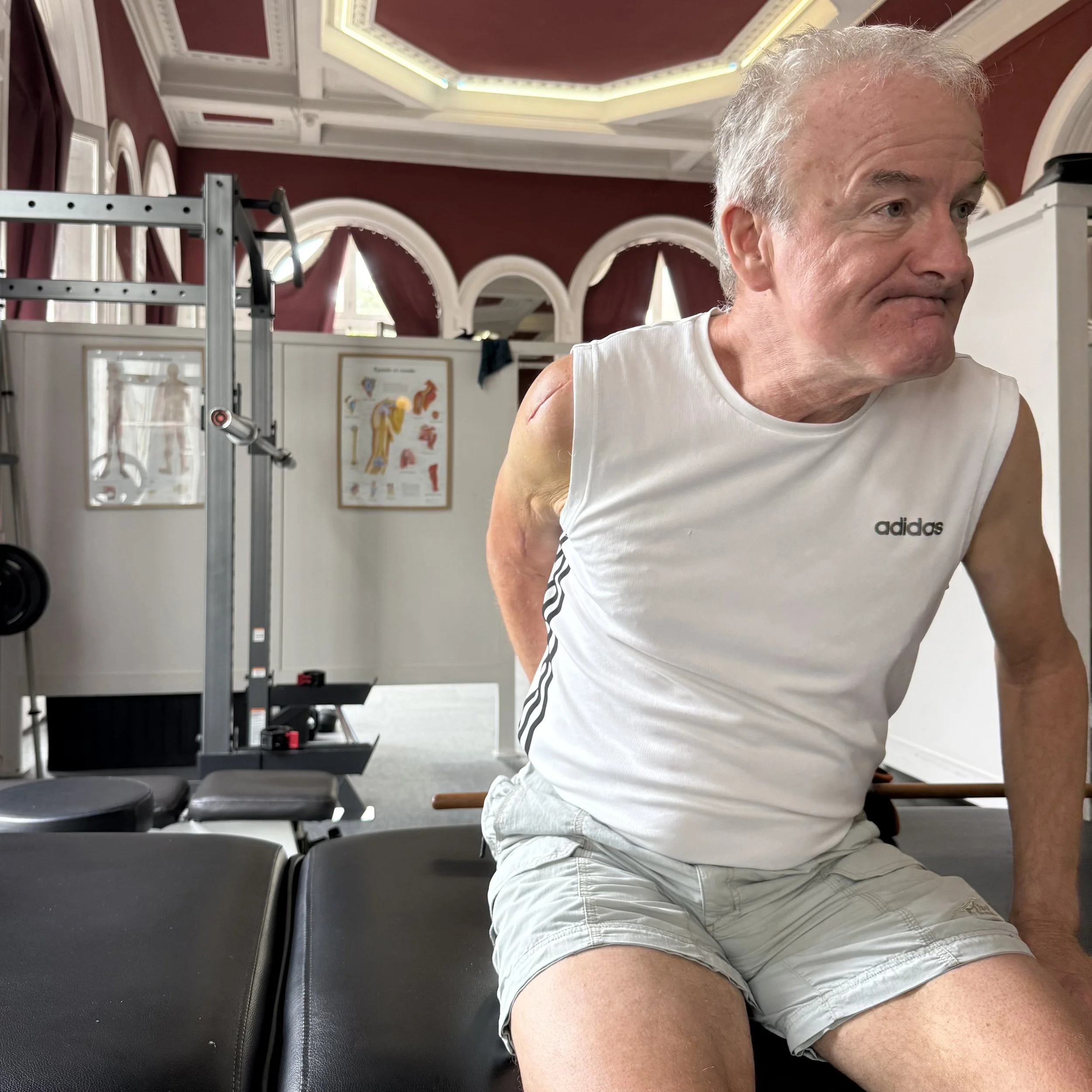
Weeks 3 & 4: New exercises each session and exponential progress. Weeks 5 & 6: Lifting pole to 90 degrees (and beyoond) with 1 KG weight and reaching arm behind his back.
Many thanks to amazing therapist, Eva Probst!
And thankfully, the French system is not burdened with paperwork. We presented JB’s “Carte Santé” to the receptionist, physical therapist, or pharmacist and that was it. No co-pay, no supplication to the insurance company to cover more, no subsequent shocking bill after final negotiations between them and the health providers, and no network limiting the choice of doctor or care facility. We were free to choose any hospital and specialist we preferred, without justification. The benefits paid for his recovery as well: the visiting nurse, physical therapy sessions, and medications. Most importantly, all the staff—orderlies, nurses, and surgical team—were top-notch, kind, and patient in their care and with providing explanations in “slow French” (or English when possible).
Though I would have preferred the summer fantasy I imagined and planned over the “medical adventure” we experienced, my over-riding sentiment is immense gratitude. Not only is my daredevil alive and on the road to recovery, but we’ve received much needed support. Christi and her husband Jean-Pierre fed and sheltered us when we were too stressed and exhausted to properly show our appreciation. Family and friends in the US, as well as friends here in France and scattered around the world, continue to send encouragement and equally important comic relief.
A few days after the operation, “Boston Bestie” Jane commiserated with me about the postponed birthday plans and my regrettable decision to abstain from alcohol (in solidarity with JB who couldn’t drown his sorrows while taking heavy duty pain killers). I responded to her empathetic, “That royally sucks.” with a resigned, “Sometimes life just gives you lemons.” Her quintessentially Jane correction was, “No. When life gives you lemons, drink lemonade and vodka.” I followed her advice the minute his last pain pill was swallowed.
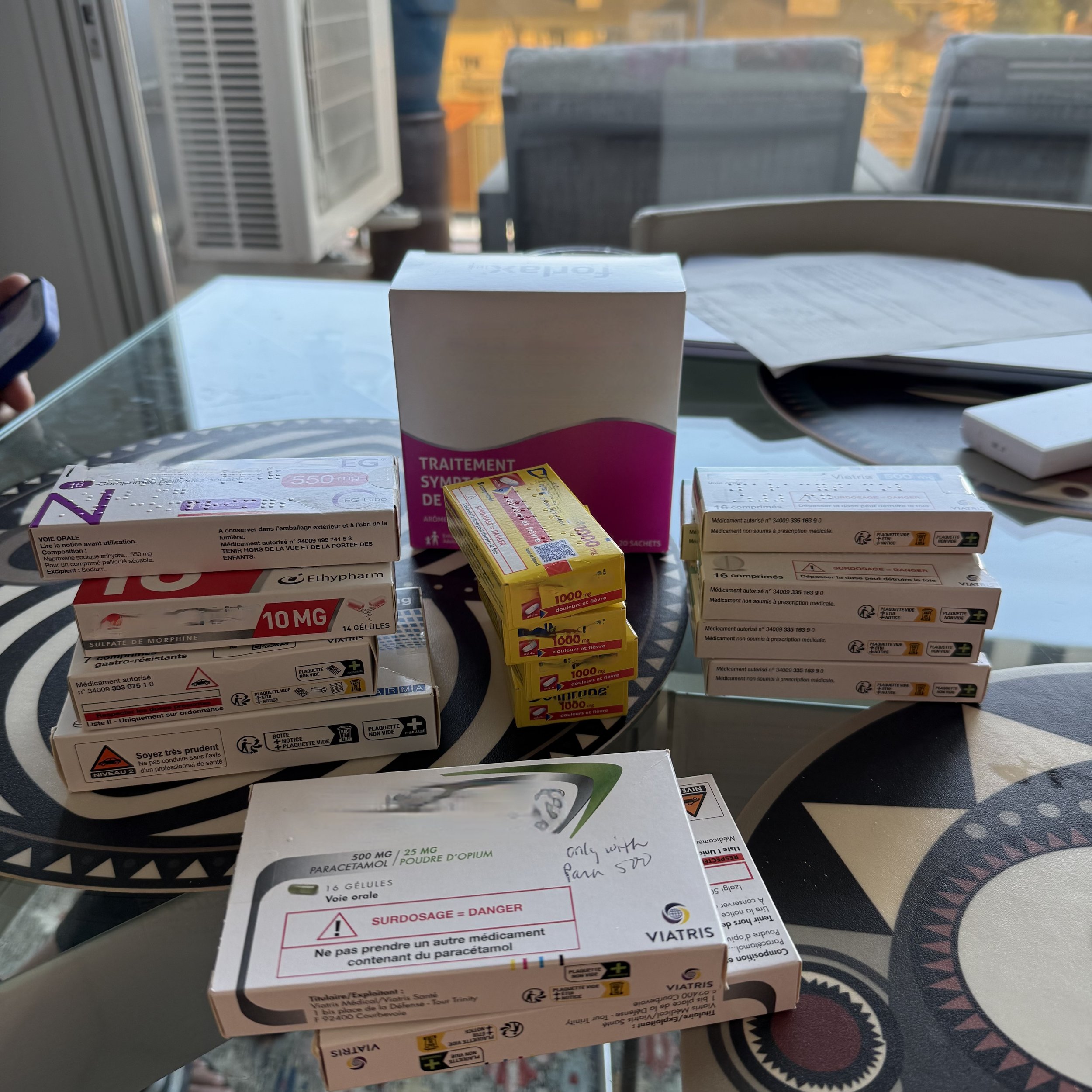
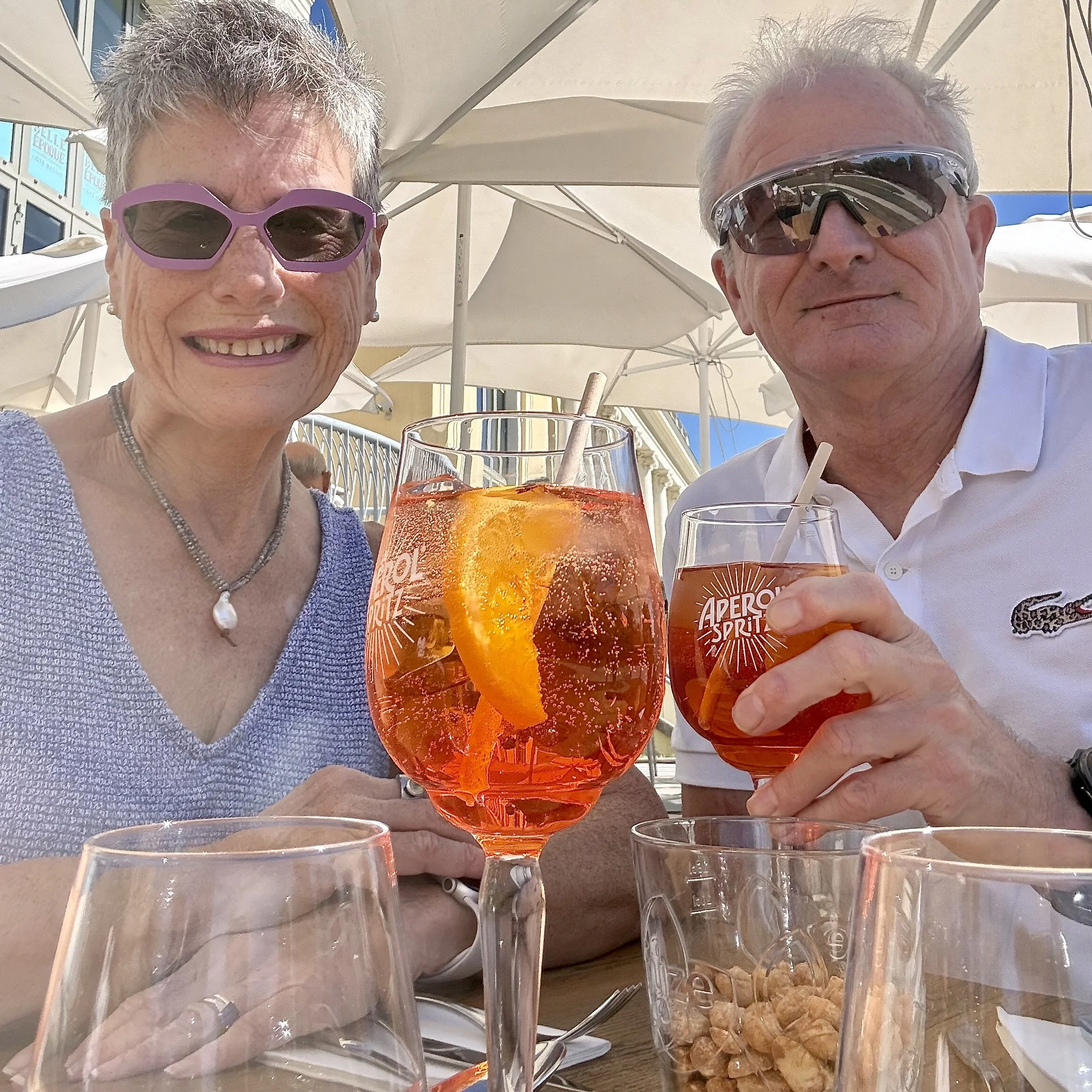
Goodbye pain pills. Hello cocktails!
A special thanks to “Maison Lapopie” who generously refunded our last-minute cancelation. We truly appreciate this gesture and look forward to staying there when we finally carry out the Dordogne plan that “went awry.” https://www.maison-lapopie.com/en