Expat or Immigrant?
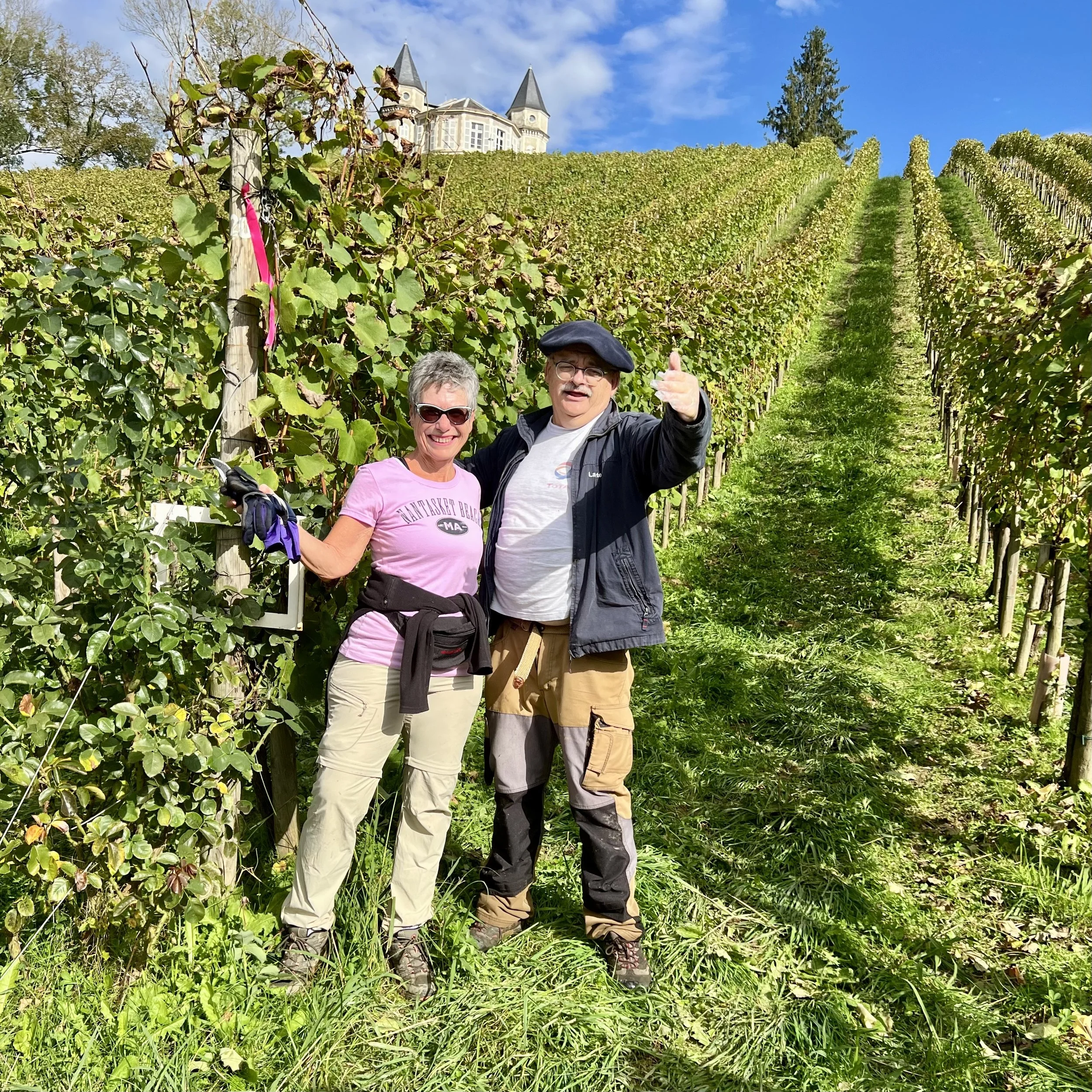
Volunteering at the local municipal vineyard, Chateau Franqueville
I suspect most good writers are, or were as children, avid readers. Growing up, our local library was my favorite place. The slightly musty, dimly lit Gothic style stone building was originally constructed as a war memorial at the end of the Civil War. For me, it was a place of mystery and magic. I would curl up in a remote corner with a pile of books, each begging to be opened, pages gently turned, and escorted home — my heart full of anticipation. After rushing through homework assignments, I was free to embark on flights of fantasy, snuggled under bedcovers with my most recent portal to another world.
Unfortunately, as an adult, bedtime reading is more of a sedative than an adventure. Travel, however, carves out hours of uninterrupted time on planes, trains, and buses for escaping into a tome filled with imagination or information. Recent months have been dominated by travel and proffered a treasure trove of captivating works, from the joyful artistry of Theo of Golden by Allen Levi to the soul-searching clarion call of “One Day, Everyone Will Have Been Against This” by Omar El Akkad. The later led me down an unanticipated path of internal debate concerning my relatively new “expat” identity.
“ Being able to look with the eyes of a foreigner is maybe the best way to see ourselves.”
Alice Rohrwacher, Italian film director
Putting this deliberation in context requires some quick “Cliff Notes” about the book’s title, content, and author. The “this” at the end of the title, refers to the bombardment of Gaza following the violent Hamas attack on Israel in October 2023. El Akkad’s controversial, but beautifully written book is an agonizing, grief filled indictment of Western policies, prejudices, and hypocrisies that led to, and supported, the Israeli government’s disproportionate military response and broad expulsion of Gazans. His personal narrative, woven seamlessly with the region’s history, offers both sides of the political aisle a compelling perspective on what it means to be the feared “other”— the stranger, the foreigner, the interloper who doesn’t “belong.”
It is a role the author knows well. El Akkad was born in Egypt, grew up in Qatar, and moved to Canada as a teen. He has resided in roughly seventeen homes and endured the nomadic existence of an international reporter before becoming an American citizen and award-winning author. The first chapter of his book introduces the subject that initiated my internal debate — the problematic connotations associated with labels ascribed to foreigners:
“In the hierarchy of migration “expat” is largely reserved for white Westerners who leave their homes for another country, usually because the money’s better there. When other people do this, they might be deemed “aliens” or “illegal” or at best “economic migrants.” As with most criteria of segregation, everyone knows, instinctively, how they will be labeled. It’s a matter of self-preservation to know.” (1)
Though his powerful critique is introduced within the context of Americans arriving in Quatar during the First Gulf War, his words resonated with me—a self-described “expat” living in France. I began mulling over the meaning of this label, and others related to the lexicon— like foreigner, stranger, migrant, and nomad. Had I mislabeled myself? Was I really an expat or was I an immigrant, and what was the difference? I wondered if El Akkad was right. Was knowing “my label” a matter of self-preservation, enlightened recognition, or are these monikers merely semantics?
According to the Oxford English Dictionary, an expatriate is “a person who lives outside their native country” while an immigrant is “a person who comes to live permanently in a country.” Therefore, all immigrants are expats but not vice versa. The distinction between the definitions suggests a matter of intent: to live temporarily in another country (be it only for the duration of a specific job or an open-ended interval to experience a different culture) versus moving permanently to another country with no intention of returning “home.” The latter is often born more of need than pleasure.
“The happy and powerful do not go into exile, and there are no surer guarantees of equality among men than poverty and misfortune.”
Alexis de Tocqueville, French Historian
In 2016, Kieren Nash, a features correspondent for the BBC, offered a similar caution to El Akkad’s, that these labels are loaded with connotations. According to Nash, the word expat “carries many preconceptions and assumptions about class, education, and privilege—just as the terms foreign worker, immigrant and migrant call to mind a different set of assumptions.” Like El Akkad, she acknowledges that “expat” is used primarily to describe “educated, rich professionals working abroad” while less privileged positions like maids or construction workers "are deemed foreign workers or migrant workers.” She cautions that “the classification matters because such language can in some cases be used as a political tool or to dehumanize.”(2)
As an example, Nash references an article by a BBC colleague that describes a global battle regarding the use of the word “migrant,” just four years after the end of the second Gulf War.(3) Although the first Gulf War had caused a migration of nearly three million people, during the intervening years, “migrant” was still commonly used as a neutral term by many western news organizations. However, the Al-Jazeera news website dropped their usage of “migrant,” claiming it can “evolve into a tool that dehumanizes and distances,” calling it “a blunt pejorative." They shifted to using “refugee” instead. The Washington Post similarly questioned if it was time to “drop the word” entirely, while a UN advisory document suggested the term “migrant” should be limited to those who “migrate freely . . . without intervention of an external compelling factor” like famine, war, or genocide.(4)
“Recognize yourself in he and she who are not like you and me.”
Carlos Fuentes, Mexican novelist, essayist, and Ambassdor to France 1975-1977
The words “migrant” and “immigrant” are even more negatively charged today. Unfortunately, the past decade has seen a serious decrease in support of “global citizenship” which Oxfam describes as “a term for social, environmental, and economic actions of individuals and communities who recognize that every person is a citizen of the world and does not see expats as migrants, immigrants, or foreigners.”(5) Unsurprisingly, that global perspective has more often been embraced by evolving nations and rejected by affluent ones. According to Global Nation, a global citizen “think-do tank”:
“2025 has seen a rare decline in public support for global solidarity across all indicators: funding global solutions is becoming less acceptable; support for international enforcement is slipping; the share of people identifying as global citizens is also eroding.”(6)
Global Nation sees this as “a worrying shift at a time when cooperation is essential for tackling climate change, pandemics and inequality.”(7)
Unfortunately, the aspirational philosophy of global citizenship doesn’t always align with the day-to-day reality of living in an adopted culture. I am so fortunate that my physical characteristics allow me to live in France under the “foreigner radar” that people of color or those wearing symbols of non-Christian faiths cannot. Woefully, there are many horrendous acts of prejudice, discrimination, and alienation, here in France, the US, and around the world. I cannot fathom the hardships that more readily identifiable foreigners experience: rising anti-immigration sentiment, mountains of bureaucratic government paperwork, finding employment while learning a new language and culture, and suffering social isolation. My expat struggles pale in comparison.
“Remember, remember always, that all of us, and you and I especially, are descended from immigrants and revolutionists.”
Franklin D. Roosevelt, 32nd President of the United States
While I’m not instantly identifiable as an outsider (until I say “Bonjour!”), I fully empathize with those who are. I lived near Tokyo, Japan for several months in my mid-twenties and it was the first time I felt alien. I will never forget my discomfort each time I heard the softly accusatory mutterings of “gaijin” (foreigner or outsider) as older people nodded in my direction on the local train. This was during the early 1980’s before any signs had English subtitles and before a curvy young woman with a fair, freckled complexion and curly auburn hair was a common sighting. I remember feeling embarrassed to be so different, offensively out of place, enormous compared to the lean, petite older demographic — many still wearing traditional garments and all with silky, straight black hair. I experienced how it felt to be in the minority, the mortification of drawing unwanted attention, the alienating sense of not belonging.
“I’m an alien, I’m a legal alien.”
Sting, songwriter and musician
Fortunately, those moments were outweighed by the kindness, positive curiosity, generosity, and respectful nature of the professionals to whom I taught English as a second language. They welcomed me in their homes, took me on cultural trips, and presented meaningful gifts to show respect and gratitude toward me as their “sensei” (teacher). One woman even took me to Kyoto, the historic capital of Japan, to visit her extended family and stay in their traditional style home. It was a step back in time, replete with “tatami” mat (woven grass) floors, an outdoor “ofuro” (a compact, deep wooden tub for hot baths), and squat style toilet.
With after dinner conversation limited to what my student host could translate, the evening entertainment became watching my long, wet hair wind into curls as it air-dried in the extreme August humidity. Unlike the gawking elders on my local train, this family was mesmerized by my unique feature as if it was a time-lapse video of a rare flower blooming. The contradictory experiences of suspect foreigner and welcome guest have undoubtedly informed my kindness toward bewildered tourists and new expats willing to face the challenges and discomforts of navigating a foreign place.
However, resolving my current designation as expat or immigrant, has not been straightforward. Though JB and I cut our US moorings when we moved to France, we had the comfort of knowing it was possible to return. We were not escaping poverty, war, or political persecution as is the case with many immigrants. While we came here with no intention of returning to the life we once had, I do sometimes entertain the hypothetical “what ifs” that could lead me back to the US someday and to view our time abroad as a once-in-a-lifetime experience. Then again, the current political climate of tribalism, dysfunction, and shrinking civil rights in the US, could just as likely recast France as a place for permanent asylum.
“What has happened to us in this country? If we study our own history, we find that we have always been ready to receive the unfortunate from other countries, and though this may seem a generous gesture on our part, we have profited a thousand fold by what they have brought us.”
Eleanor Roosevelt, First Lady and US delegate to the United Nations Assembly 1945-1952
As retirees on a modest, fixed income we are not exactly El Akkad’s or Nash’s typically wealthy, job-seeking expats. We did not come here for better employment, though the lower cost of living was a draw. We primarily came to experience a new culture and new way of life. Nevertheless, thriving in a different culture takes time. It requires shedding old ways of doing things and adopting new norms — a necessary transition from long-term tourists to permanent residents. All things considered, it appears we fall into a murky, overlapping ellipse within the Venn diagram of two universes: privileged expats and determined immigrants. Simply because we have a choice, and are not pressed by the necessities that brought our own immigrant ancestors to the US, the subtitle of this website will remain:“An Expat Writer Responds to Living Abroad” — at least for now . . .
"Do not mistreat the stranger living in your land, but treat him just as you treat the native among you. Love strangers as you love yourselves, because you were strangers once . . .”
Leviticus 19:33-34
Recent Reading Recommendations:
Lincoln in the Bardo, George Saunders (Random House)
Theo of Golden , Allen Levi (Atria Books)
Audition, Katie Kitamura ( Riverhead Books)
The Safekeep, Yale Van Der Wooden (Avid Reader Press / Simon & Schuster
One Day, Everyone Will Have Been Against This, Omar El Akkad. (Picador/Canongate Books Ltd
Cosmic Connections— Poetry in the Age of Disenchantment, Charles Taylor (Belknap Press: An Imprint of Harvard University Press)
Footnotes:
(1) Omar El Akkad, One Day, Everyone Will have been Against This . UK,Picador/Canongate Books Ltd., June 11, 2025, page 12.
(2) Nash, Kieran. The difference between an expat and an immigrant? Semantics. BBC (online). January 20, 2017. https://www.bbc.com/worklife/article/20170119-who-should-be-called-an-expat
(3) Ruz, Camilla. The Battle Over the Words Used to Describe Immigrants. BBC News Magazine (online). August 28, 2015. https://www.bbc.com/news/magazine-34061097
(4) Ruz, Camilla, ibid.
(5) Oxfam website homepage. https://www.oxfam.org.uk/education/who-we-are/what-is-global-citizenship/#:~:text=Global%20citizenship%20is%20the%20term,a%20citizen%20of%20the%20world.
(6) Global Nation website. Global Solidarity in 2025: Trends in Public Opinion. Jason, Sharon. Divorce Skyrocketing Among Aging Boomers. AARP. November 27, 2025. https://globalnation.substack.com/p/global-solidarity-in-2025-trends
(7) Global Nation, ibid.