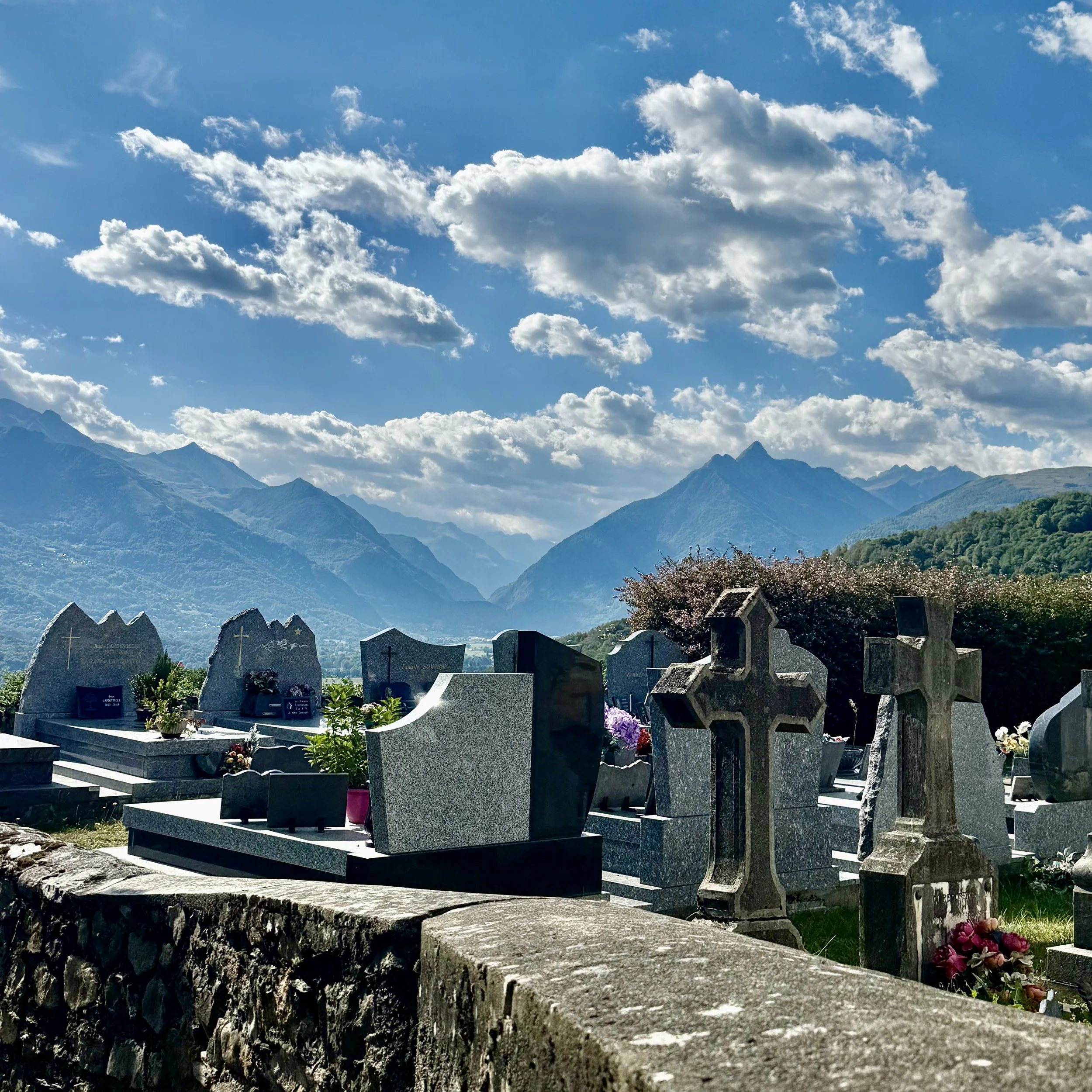
“The half-life of grief is endless.”
Ken Burns, Anderson Cooper “All There is” podcast (1)
Grief. An unavoidable human experience. Eventually, we all suffer the end of a relationship, the loss of health or physical capacity, and the death of someone we love. For the first time, JB and I have faced the death of a dear friend in France. As with many firsts in this expat life, it connected us more deeply to the life and community we have adopted.
JB and I are no strangers to grief. We have both lost parents, siblings, and friends. Regardless of one’s age at the time, the first experience of grief forces a reckoning with mortality and its immutability—concepts that perhaps until then, were only abstractions. We continue to grapple with their reality in each loss thereafter.
My father’s sudden death, a month after he retired, was my first introduction to grief. Nearly 40 years later, I still remember the overwhelming shock and disbelief I felt—how could the world just keep revolving as if nothing had happened, despite the seismic upheaval of my universe? Everything became weighted with a new, spirt breaking knowledge: the defining force in my family, and my north star, had been extinguished. The pain of that loss was layered over every moment.
"Her absence is like the sky, spread over everything.”
C.S. Lewis, “A Grief Observed”
For me, anger came quickly on the heels of shock and denial. It shattered my religious faith and shook the foundations of my sense of security in this world. JB and I both questioned why a loving father would be taken while one who wreaked havoc (like his) was not. That anger was mixed with the fear of what life would be without my guiding light. I felt fully “adult” for the first time—as if I had suddenly taken over the steering wheel of my future, without my copilot. Though the anguish of that loss has faded over time, it has never left completely. I’ve learned the truth: time does not “heal all wounds.”
However, there is some comfort in knowing that many aspects of grief are shared by others: shock, denial, anger, bargaining, depression, acceptance, and eventually, hope. While these are commonly referred to as “the stages of grief,” current psychology indicates that they are not experienced in an orderly progression and none are mandatory.(2) Navigating grief can be more accurately described as a dual process of loss and restoration.(3) In other words, while dealing with the emotional pain we begin to accept new realities—including adaption to new roles and changes in identity. I recall that when my older brother died, I became acutely aware of my new ranking as “eldest child,” even though in many respects I had always assumed its responsibilities. His death ratified what was already true but also made me feel the full weight of it.
The harsh reality is that we don’t “get over” someone’s death; we learn to coexist with it. The process knows no timeline or steady progression. Its emotional “oscillation” between loss and restoration, while perhaps unnerving to those trying to comfort us, is actually an indication of healthy grieving.(4) Bereavement would be unbearable without moments of relief—laughter, distractions, and engagement with ongoing life. Gradually, we learn to hobble about, from making our morning coffee, to returning to work, and going out with friends. In our own time, and on our own terms, we negotiate our way back to embracing life.
“The death of a beloved is an amputation. At present I am learning to get about on crutches. Perhaps I shall presently be given a wooden leg. But I shall never be a biped again.”
C. S. Lewis, “A Grief Observed”
The loss of our cherished friend, Jean-Claude, is so recent that we still find ourselves vacillating between denial and acceptance. His death was oddly unexpected; despite complications he was experiencing from a recent surgery for re-occurring cancer. After weeks of emergency return trips to the hospital, dwindling strength, and heavy medication, he had begun to slowly regain his appetite, take short walks, and run errands by car. But each time we saw him, he repeated a “fear of the worst” regarding yet another surgery in September. Despite these foreshadows, we grasped at hope. Afterall, we had witnessed his previous, miraculous recovery from stage 4 cancer. As the day approached, Jean-Claude promised to send a message post-surgery. Instead, his brother and a neighbor knocked on our door to deliver the news that Jean-Claude’s battle with cancer had ended abruptly.
“Give sorrow words; the grief that does not speak whispers the o'er-fraught heart and bids it break."
Shakespeare, “Macbeth” (Act 4, Scene 3)
Unsurprisingly, I am compelled to immortalize him and our friendship in words. Jean-Claude was the first neighbor we met after buying our apartment, directly below his. He became our first French friend, and over the next eight years, our “go to person” for navigating daily French life—from recommending who to contact for home repairs, to where to buy the best “foie gras,” to what cultural events not to miss. He loved to entertain and frequently hosted fabulous “apertif dinatoirs” (cocktail style dinners) to help us build friendships with an ever-expanding pack of other neighbors. A man of exquisite taste, Jean-Claude always set the table with elegant china, crystal, linens, and an abundance of champagne.
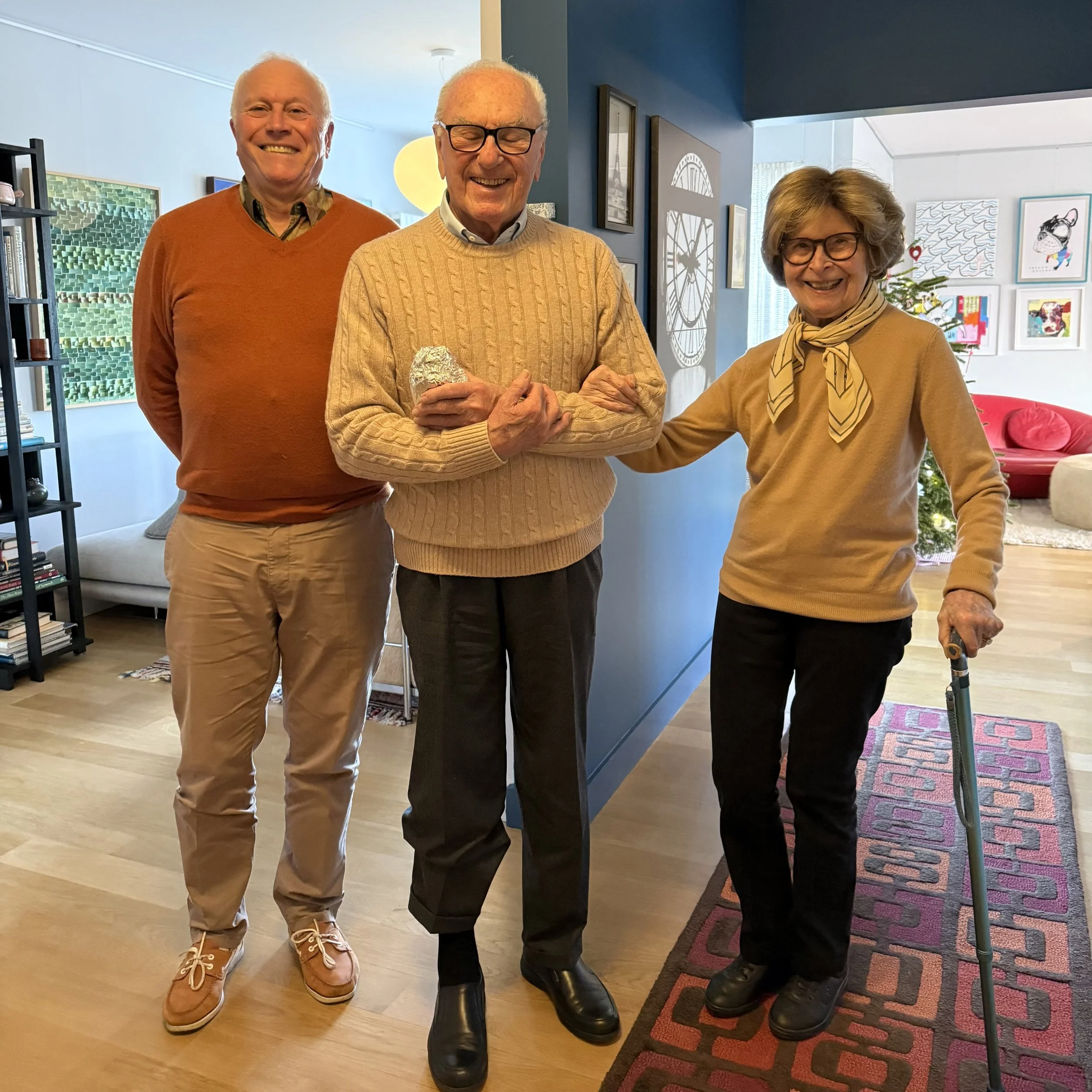
The original “Dinatoir Nucleus” — Jean-Claude, Jaques, and Michelle.
Jean-Claude was deeply interested in other cultures and had lived in Africa for many years while working for Total, the French oil company. A serious and enthusiastic traveler, he would take language courses to improve his understanding of, and interaction with, the culture of a new destination. Jean-Claude was also well versed in history and followed the US political scene more carefully than most Americans. He never shied from challenging discussions. His discourse was always peppered with a sharp wit, but softened by a kind, generous spirit.
He also loved rugby, classical music, and theater. Hardly a day passed that Jean-Claude didn’t have plans to share one of his many passions with friends or family. And most Sunday afternoons he held court on his terrace overlooking a prized view of the Pyrenees. The hours passed on an endless flow of conversation and champagne.
I recall our first introduction to that beloved ritual. We were “camping out” in our apartment with no furniture other than an air mattress and outdoor chairs from the local “bricolage” (home improvement store). We had spent a frustrating morning attempting to remove stubborn wallpaper that covered walls, ceilings, and doors. While taking a break on our terrace, we suddenly heard cheerful “bonjours” and enthusiastic invitations, from a cluster of torsos hanging over the railing above, to come join the party.
Still in grubby work clothes, sweaty, and exhausted, my instinct was to hide inside, but it was too late for that. Jean-Claude’s eccentric cousin, Chantal, would not take “non” for an answer, so we agreed to arrive in five minutes. We quickly ripped off work clothes, threw on the nearest clean options, and put on our best faces (mine with a quick slap of lipstick accompanied by a spritz of perfume). While there was a lot of “Franglish” spoken that afternoon—and the consumption of too much alcohol—the revelry cemented our fledgling friendship.
“In the garden of memory, in the palace of dreams... that is where you and I shall meet.”
Lewis Carrol, “Alice Through the Looking Glass”
In the days following the shocking news of Jean-Claude’s death, our circle of “dinatoir” neighbors consoled each other in hallways, ordered flowers for the funeral, and planned ride sharing to the church. JB was unwell and sadly unable to attend so I was happy to chauffeur two neighbors, Ghislaine and Jacques. The brief journey proved to be one of those much-needed moments of restoration amid loss.
The very sophisticated Ghislaine had moved back to Pau from Paris the previous year and I had found it difficult to connect with her. Jacques has a hilarious sense of humor in both French and English. His lovely wife Michelle suffers from Parkinson’s disease and couldn’t join us. Although Jaques’ deteriorating eyesight restricts him from driving, he insisted on directing us to the church in the nearby village of Morlaas. I exchanged a knowing look with Ghislane in my rear-view mirror. We shared a well-founded fear of embarking on a “Mr. Magoo” journey.
Luckily, we had departed with enough time for several wrong-turn detours. Before long we found ourselves deep in cow pastures with no village in sight. Jacques reluctantly acquiesced to using GPS. The remaining ride was just long enough for him to entertain us with an imitation of the voice directing our route. His interpretation of the American accent was an odd conglomeration of mid-western news anchor, southern “belle,” and southwestern French.
Once we arrived, the beautiful, medieval church of Jean-Claude’s childhood quickly filled with family, friends, and neighbors. Those who spoke, shared stories that echoed our experience of this multi-faceted gentleman. Following the service, the full contingency from our building gathered in the courtyard to comfort each other and extend condolences to Jean-Claude’s family. Since then, there has been a palpable shift in intimacy among us and any reservations I had with Ghislane dissolved in shared tears.
"Grief knits two hearts in closer bonds than happiness ever can; and common sufferings are far stronger links than common joys."
Alphonse de Lamartine, “Raphael: Or, Pages of the Book of Life at Twenty”
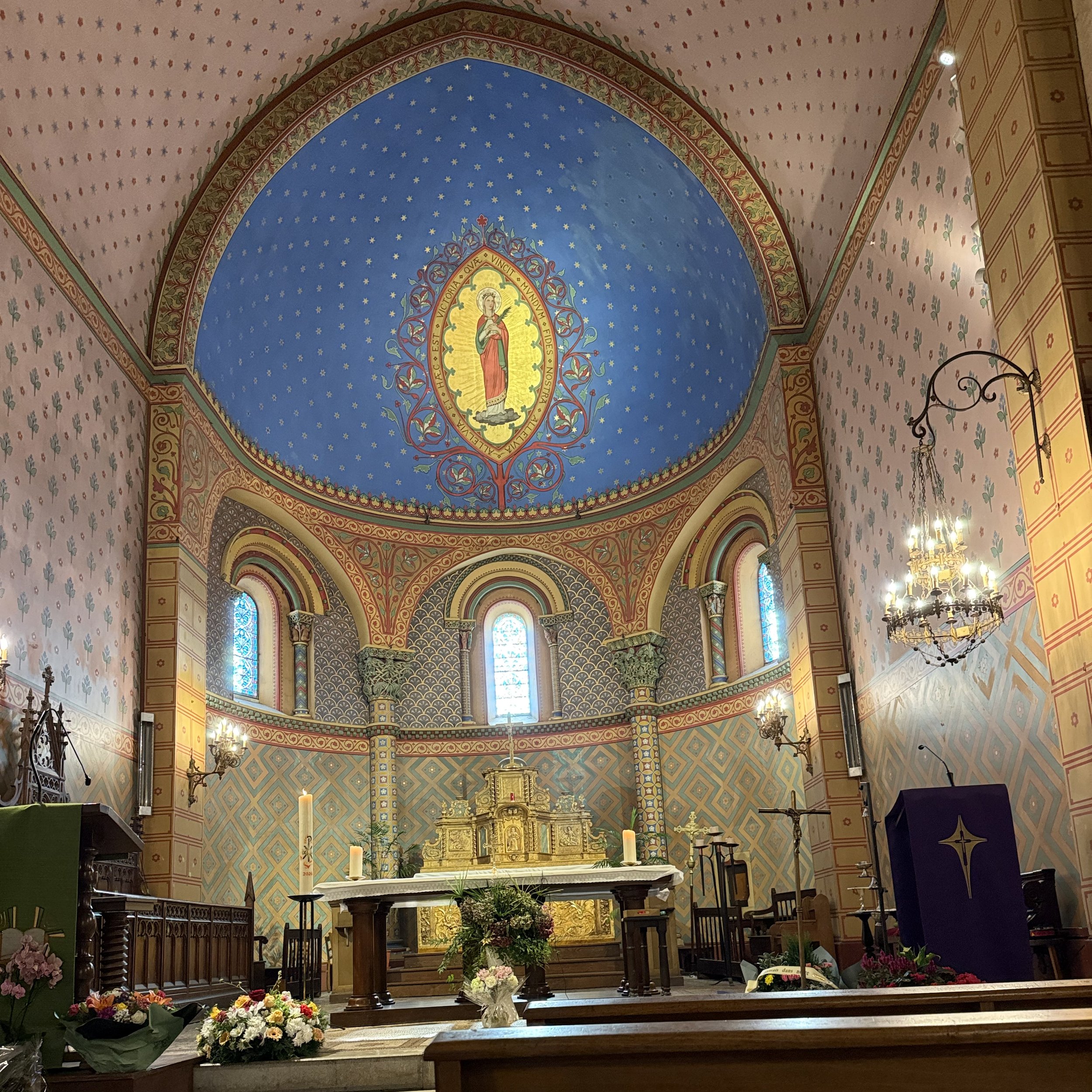
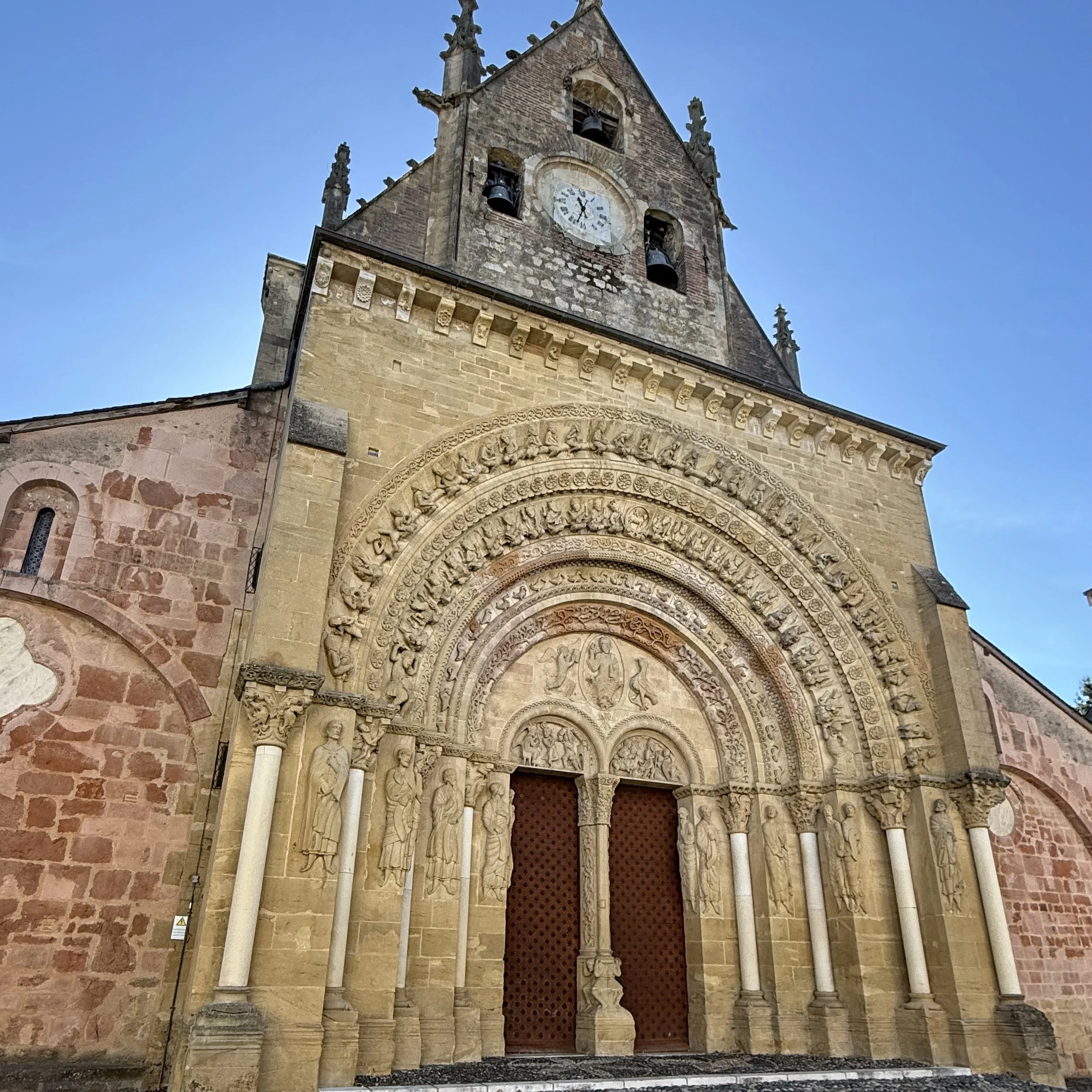
Église Saint-Foy — Morlaas, France
Jean-Claude’s death has reminded me that while grief’s journey may be marked by familiar milestones, it never takes the same path. Its pace, where it leads, and how it impacts us is as unique as the person we’ve lost. As JB and I once again traverse this difficult terrain, we’ll draw from a reservoir of treasured memories and lean upon deepened connection with our neighbors. While we still can’t fathom that someday, someone else will occupy the home above us, we hope to extend Jean-Claude’s kindness to whomever inherits the community he so fervently nurtured. Meanwhile, we’ll gratefully channel his exemplary “joie de vivre” each time we lift a glass of champagne on our terrace to celebrate the eternal beauty of the Pyrenees he so loved.
"Say not in grief 'he is no more' but live in thankfulness that he was."
Hebrew proverb
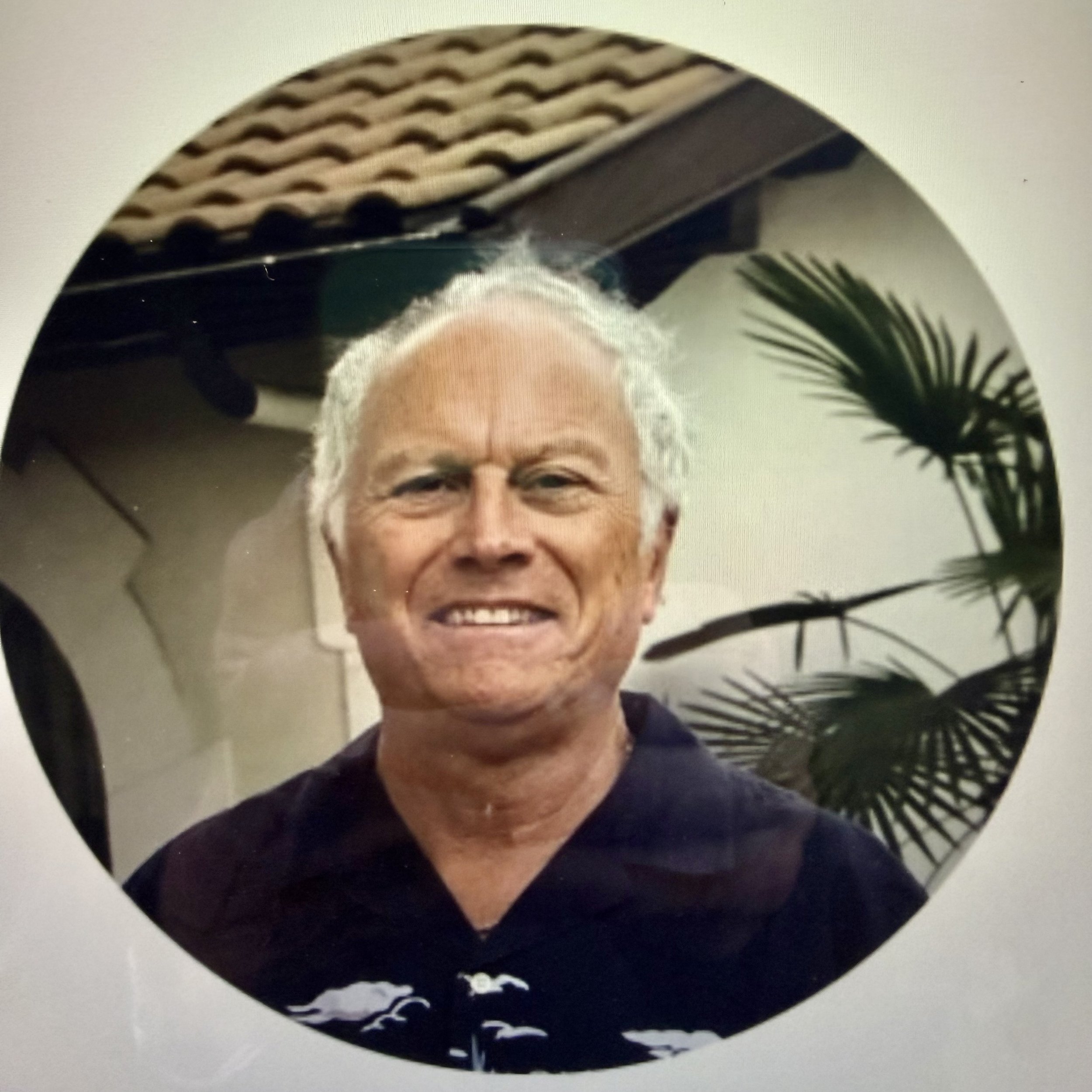
Jean-Claude Mehats
Footnotes:
1. Anderson Cooper podcast, “All There Is.” “Ken Burn’s History with Grief,” November 4, 2025. https://www.iheart.com/podcast/867-all-there-is-with-anderson-101788968/episode/ken-burns-history-with-grief-305013558
2. Maciejewski, Paul K., et al, “An Empirical Examination of the Stage Theory of Grief.” JAMA, February 21,2007. https://jamanetwork.com/journals/jama/fullarticle/205661
3. Stroebe, Margaret and Henk, Schut, “The Dual Process Mode of Coping with Bereavement: Rational and Description.” Taylor & Francis Death Studies Journal, Published online November 11, 2010. https://www.tandfonline.com/doi/abs/10.1080/074811899201046
4. Simply Psychology Today Editorial, “Beyond the Five Stages of Grief: What Modern Research Actually Tells Us,” April 1, 2026. https://www.simplypsychology.com/articles/beyond-five-stages-grief