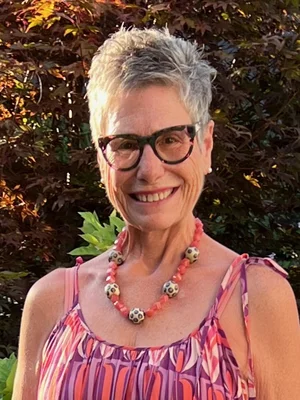
A Coal Miner’s Daughter
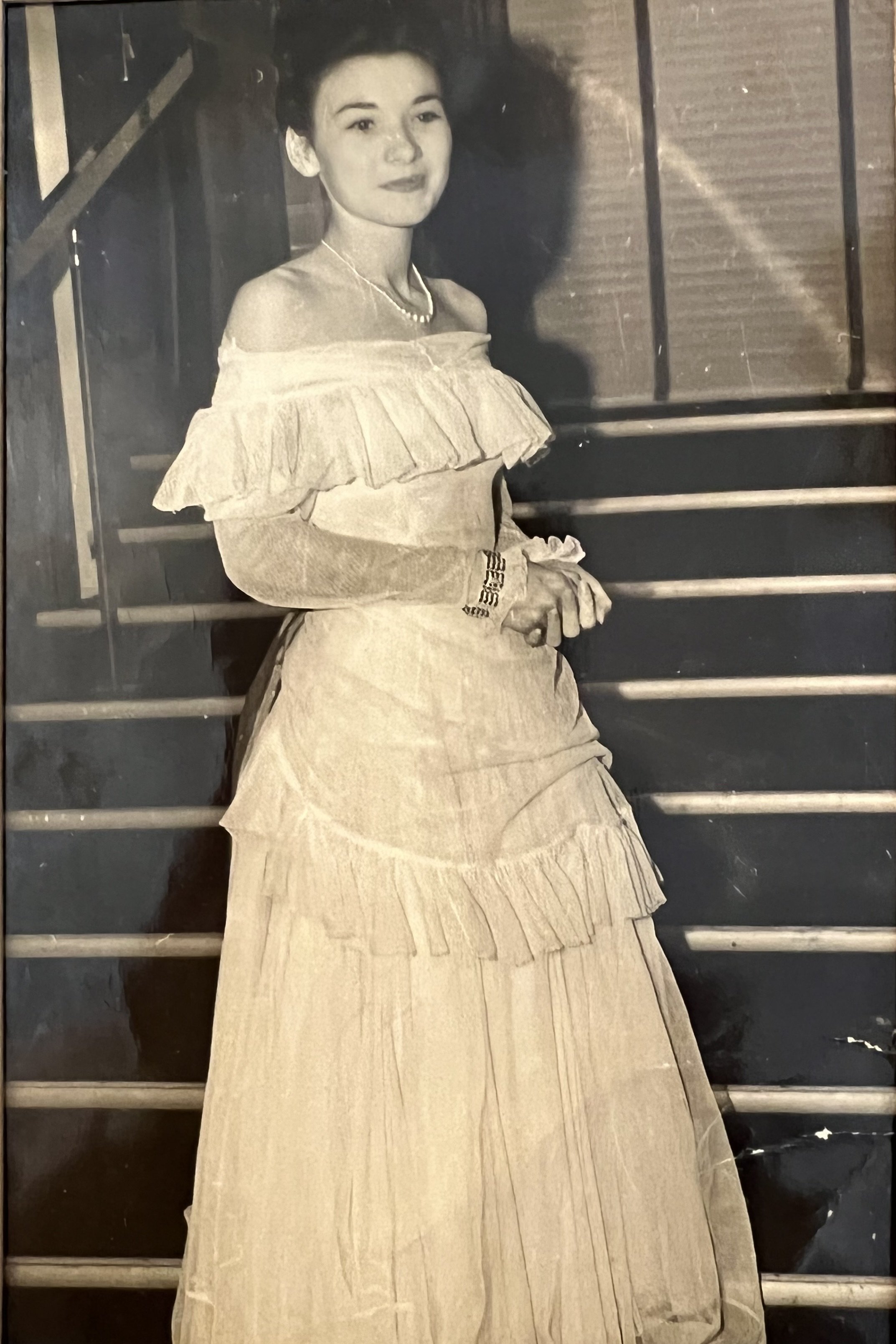
Mom dressed for a high school event in one of her mother’s singular creations.
A legacy of love…
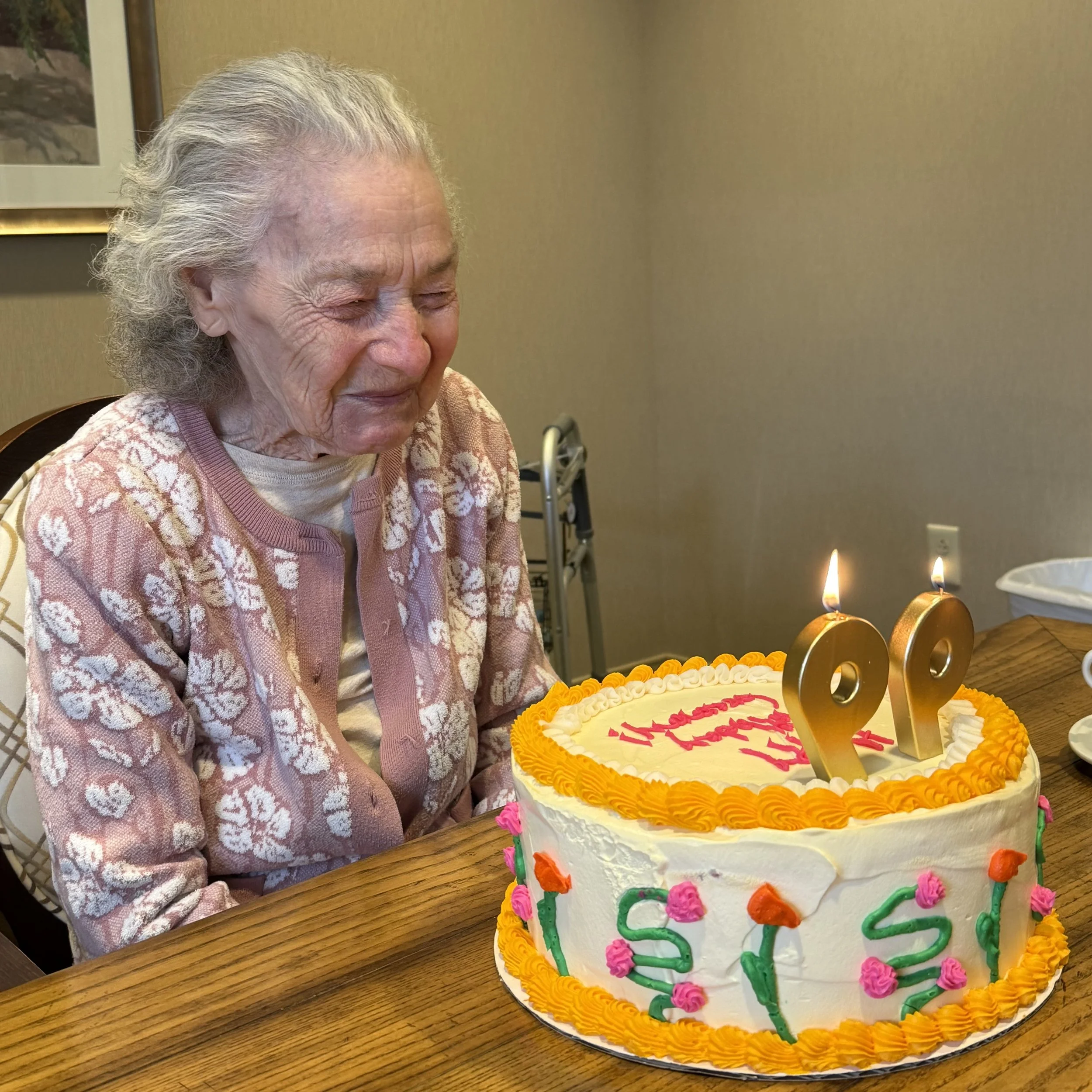
My family recently gathered to celebrate my mother’s 99th birthday. How extraordinary to have witnessed nearly a century of history: from Pearl Harbor to a lunar landing and the mapping of the human genome. While adapting to a world changing at warp speed, she has experienced many immeasurable joys and more than her share of unbearable sorrows. My mother has built a legacy of love that has nourished sisters, friends, a husband, children, and grandchildren (one by birth, and many “adopted” over decades as a Sunday School teacher). She has courageously navigated the past 39 years without the love of her life.
She was born in Chicago but grew up in rural Oklahoma. Like country singer Loretta Lynn, my mother was “born a coal miner’s daughter.” Her father’s family emigrated from Scotland during his teens. Despite dashing good looks, he was shy about the attention drawn by his “brogue” and abandoned school to work alongside his older brothers in the coal mines, about an hour south of Tulsa, Oklahoma. Her mother was a scrappy, “serial entrepreneur” whose family had been in the US for several generations—my great-great grandmother was one of only several pioneer women to stake out property in the “Land Run of 1889” (a US government sponsored “land grab” within Indian Territory, now the state of Oklahoma). My mother’s parents married before her mother finished high school. Following my mother’s birth several years later, ambition for a better life pushed my grandmother to finish high school, attend college, and eventually become a schoolteacher—all while raising three girls, each born a decade apart.
While growing up, the family’s “shot gun” style bungalow had no electricity and no indoor toilet until my mother was almost a teen. Most of her clothes were skillfully fashioned by her mother from flour sacks and Salvation Army finds. With designs inspired by newspaper society photos, she was likely the most fashionable girl in small-town Dewar. When the mines closed in the late 1930s, on the heels of a decade of crop failures, her father scrambled to find work in the suffering economy. He taught himself how to run electricity in his and neighbors’ homes and somehow deciphered the operation and maintenance of the town cinema’s movie projector—a job that fed his passion for “spaghetti westerns” and my mother’s love of the “dailies” that offered a peek into upcoming Hollywood romance films.
Yet, much like the lyrics of Loretta’s song, my mother’s Depression Era hardships were offset by a tightknit community and a loving extended family whose stories of coming to America fed her imagination and creativity.
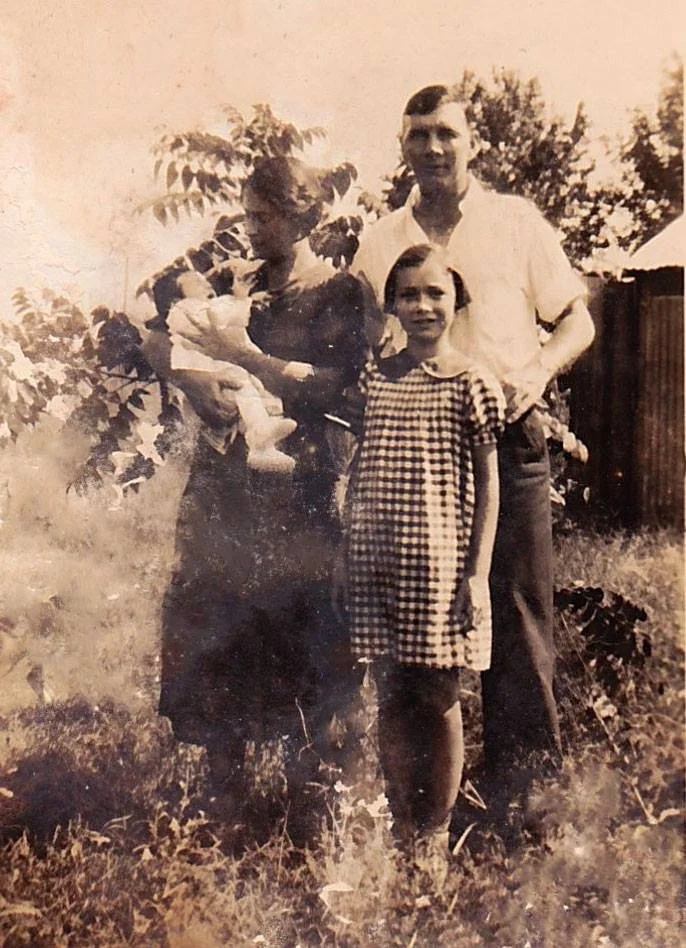
My mother, her parents, and baby sister.
An irrespressible storyteller…
My mother became an artist, a teacher, and an irrepressible storyteller herself. She has always been able to relay the simplest recollection with cinematic detail and color. When we were kids, most weekends involved a road trip to visit family, to explore a local historic site, or to satisfy a craving for farm fresh ice-cream (an addiction inherited from our mother). Mom would inevitably wonder aloud about some random “snapshot” that caught her eye in the rapid panorama flashing past the station wagon windows. In an instant, a barn, a dog, or a dilapidated building conjured fully fleshed dramas, often commencing with “I wonder . . .” or “what if . . .”. She also threw herself into our school projects, suggesting home-made clay, plaster of Paris, or other creative devices for telling a story or materializing an elusive concept.
This hallmark birthday is a bitter-sweet occasion. While a remarkably long life is worthy of jubilation—and a decadent ice-cream cake—it comes with numerous “trade-offs.” Rarely is such longevity achieved without physical and/or mental compromise. While my mother is still blessed with mobility, a stealthy predator has been slowly and silently stealing her from us for over a decade. Bit by bit, dementia has obscured and erased most of her memory and taken the heart of who she was with it: a fashionable beauty, a woman of uncompromising faith, a giver of gentle support and unconditional love, an unbreakable spirit in the face of tragedy, and the guardian of family lore.
Her mental decline has followed a “Benjamin Button” progression: while losing grip on the present she has retreated to her past. The changing characters in her stories, repeated on a seemingly endless loop, began their regression in the more recent past, focusing on meeting my father in college and then raising their four children. Gradually these memories faded, and sometimes inaccurately merged with recollections of her parents and raising their children. The preoccupations gradually crept further back to her maternal grandparents, especially her grandmother, who served as a surrogate mother while hers focused on studies and work.
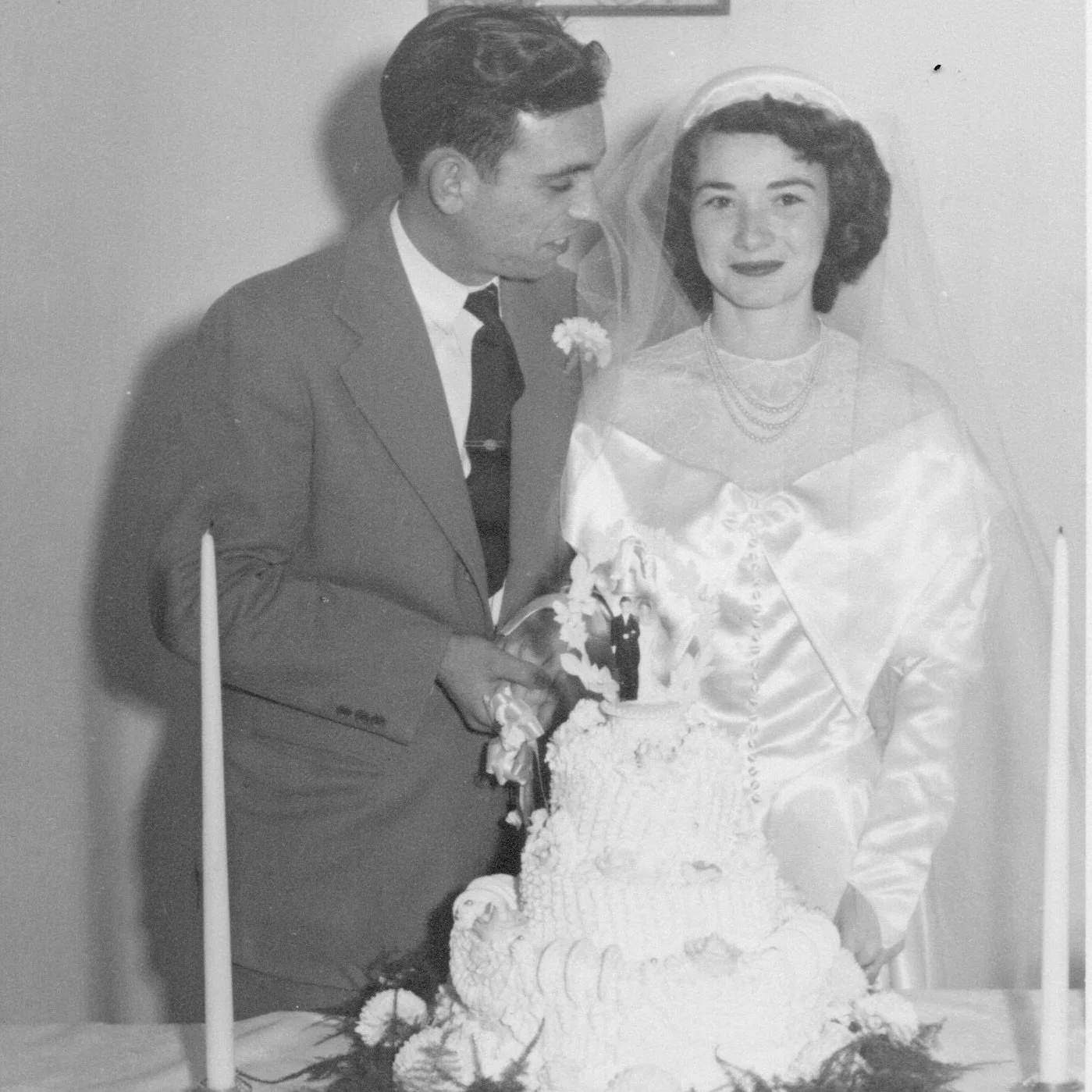
November 11, 1949: Dad and Mom (the bridal gown created by her mother).
Mom’s favorite reoccurring tale was about visiting the home where her father was raised— the youngest of six boys and one girl. His eldest sibling, Mary, cared for their aging parents and managed the household while her brothers spent long days in the coal mines. Long after their parents died, Mary continued to live in the homestead and the extended family returned there each Sunday to share a meal and exchange stories. Mom would nostalgically recount for us her weekly “after church” journey on foot to Aunt Mary’s: the hot dusty road, the gentleness and security of walking hand-in-hand with her father, the anticipation of time with her beloved aunt, and the occasional “lift” from a farmer in a rusty, rattling truck.
One particularly memorable Sunday, Aunt Mary caught my mother peering into a musty old cabinet that had survived the trans-Atlantic voyage from Scotland, nestled in the hull of the ship with the rest of the family’s possessions. When asked why she was snooping, my mother turned to her aunt and exclaimed, “because I can smell Scotland!” Mom’s retelling of the moment consistently conveyed with clarity, Aunt Mary’s silent, tearful departure to another room—a reaction that baffled my young mother. The image was always so vivid that I too could “smell Scotland,” feel the child’s bewilderment, and the woman’s painful remembrance of everything her family had left behind.
A silver lining…
I’m certain my own passion for storytelling was born from my mother’s verbal legacy, and if there is a silver lining to her dementia, it’s that the constant repetition of that seminal childhood moment—as well as many other family stories—has burned them into my own memory. However, it has robbed me of others. I so wish I had memories of my mother visiting our home in France, but sadly that never came to fruition. The rapid ravage of dementia during the COVID lock-down dashed that hope. While hospitalized, due to a fall, her doctors determined that she could no longer live safely at home. Unfortunately, assisted living was the only viable option. Within three years, she was in memory care. This has made me treasure even more the two vacations we spent with my mother in Switzerland, while she was still sharp and spry in her late ‘70’s and early ‘80’s.
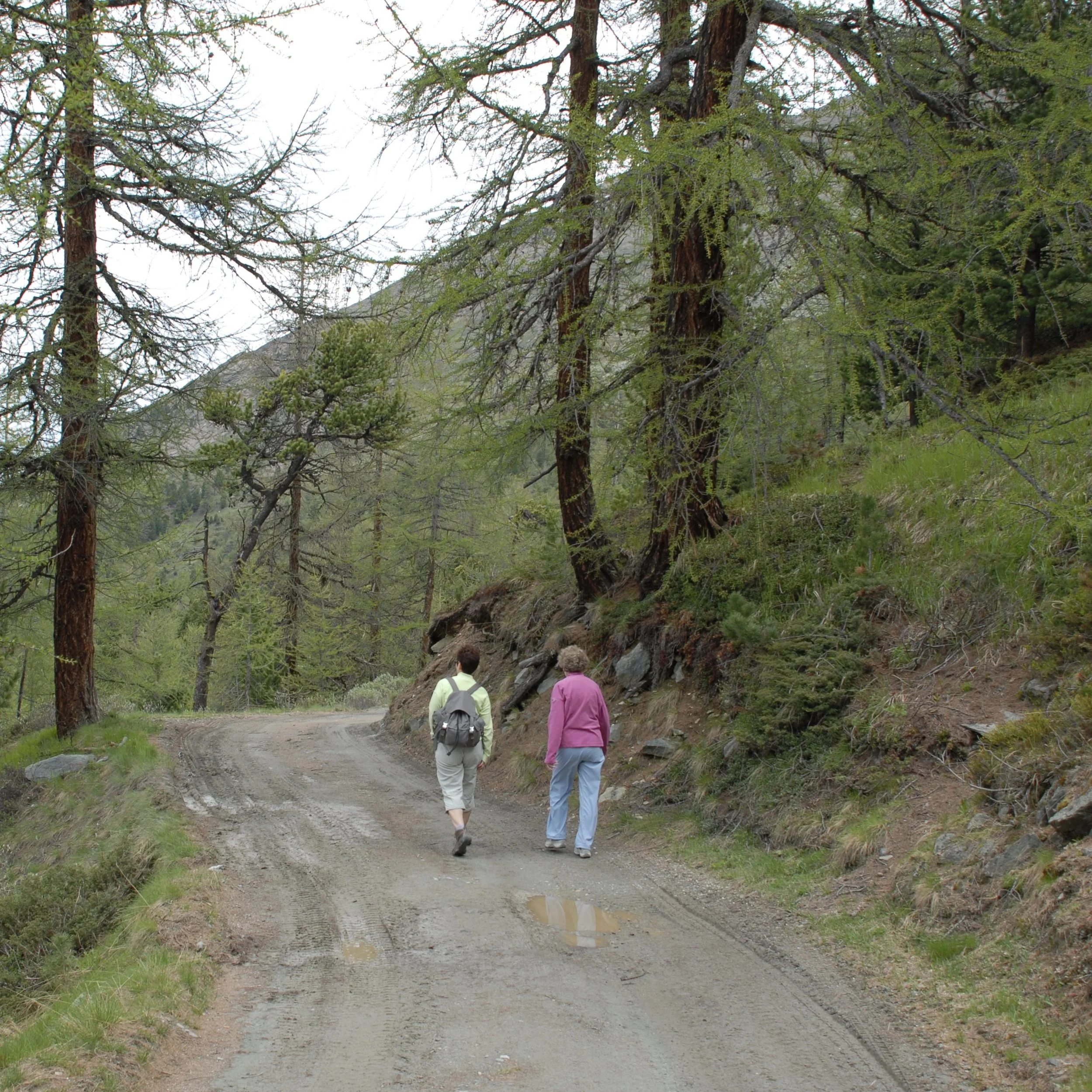
As travel often does, these journeys opened newer and deeper connections between us. Upon arrival in Zermatt, my mother shared that she had always been fascinated with Switzerland—had written a school paper about its farming culture and snowy landscapes and had dreamed of standing in the presence of the magnificent Alps. When I expressed my shock that she had never said anything when viewing photos from my previous trips, Mom characteristically responded that she never wanted to impose herself on us or our vacation plans. Her inability to voice her needs or wants has always frustrated me, but thankfully in this case we unknowingly made her dream come true. It was an unforgettable gift to experience her childlike excitement as we explored Zurich, traveled by train to Zermatt through a valley of glacier lakes, wandered gentle hiking trails, and rose to dizzying heights on a gravity defying cog-rail to witness spectacular alpine views.
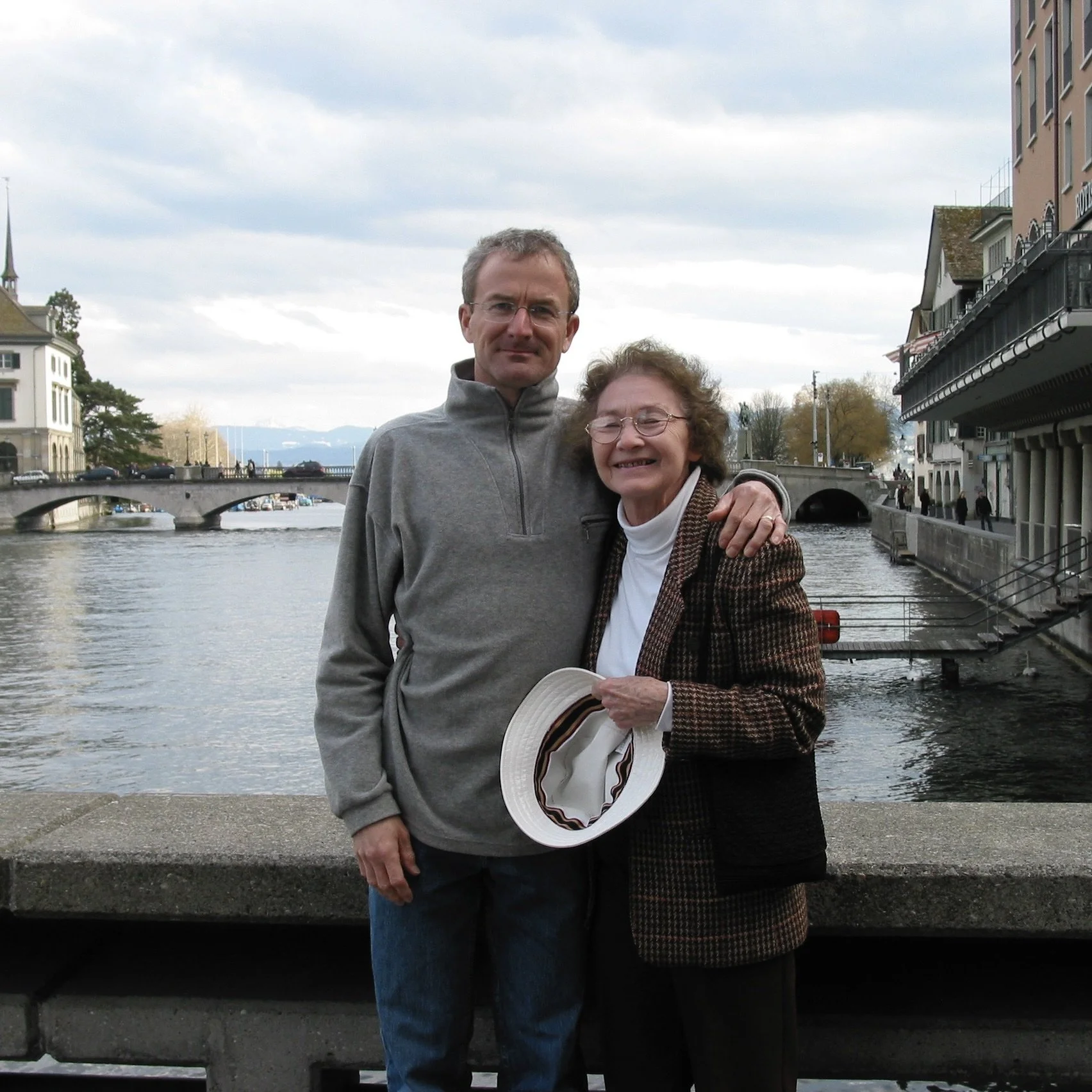
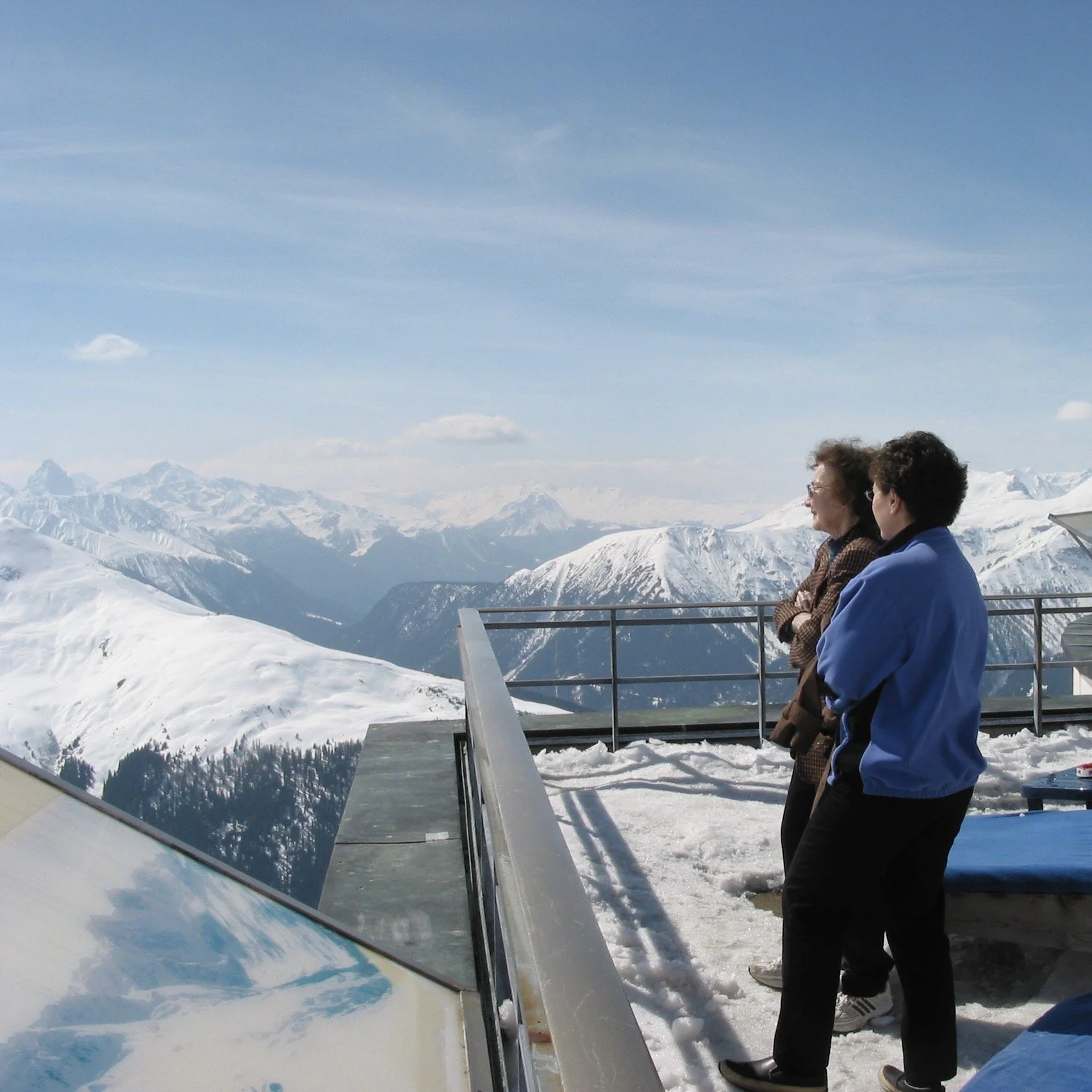
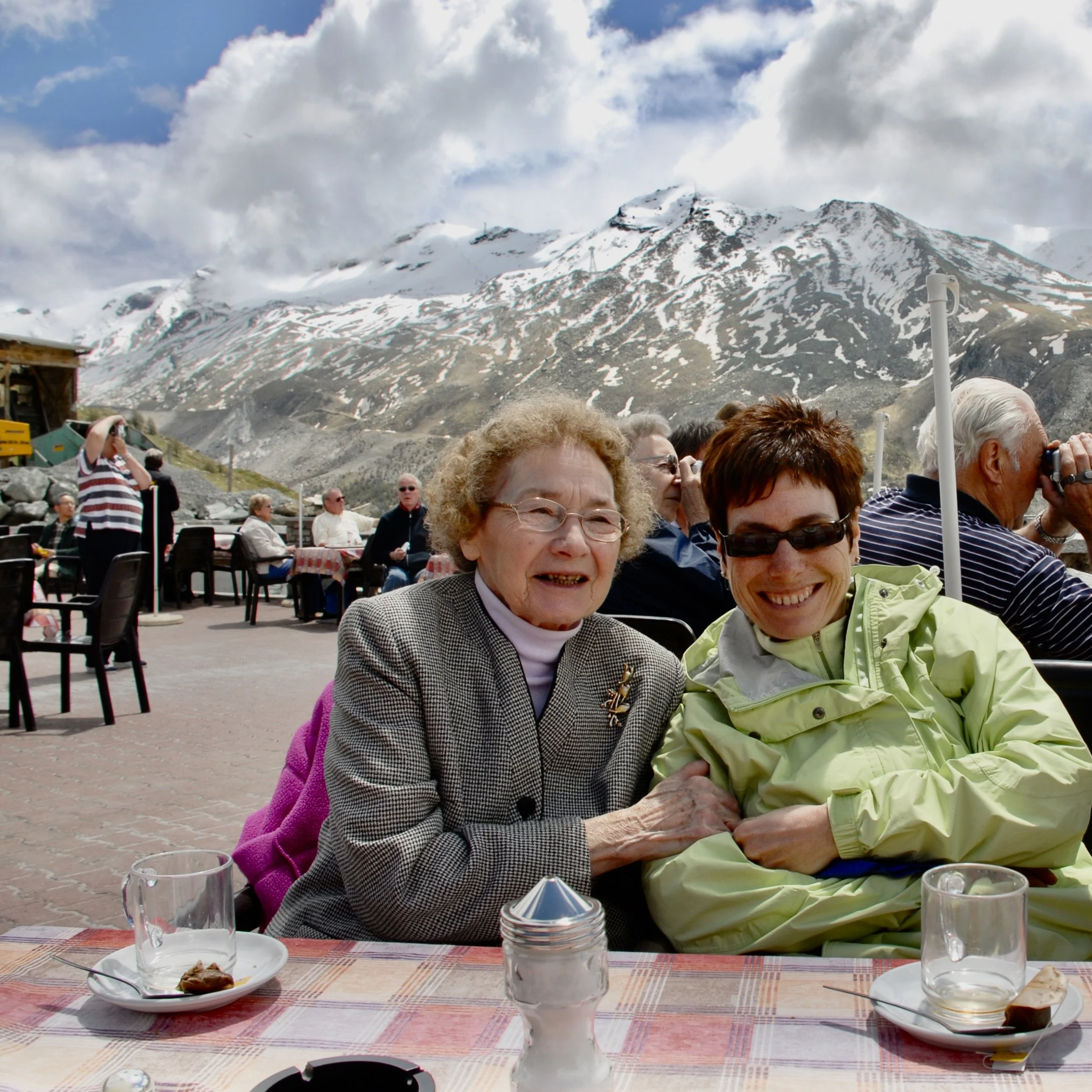
Similarly, I only learned as an adult that when my mother was a young woman, she had aspired to be a magazine illustrator in Chicago. She adored the architecture and energy of the “Windy City” when visiting cousins there during her childhood. Ultimately, she shifted her academic focus to art education as a more career friendly option for raising a family. Though my mother never voiced regret, I believe the weight of her sacrifice motivated the encouragement she has always given me to pursue my career and travel ambitions.
Guilt, fear, and mercy…
As my mother’s eldest living child, I feel obligated to carry forward the stories my siblings are too young to have witnessed or remember. I also find myself occasionally taking a mental inventory of inherited objects and photos that need to be documented and passed on to my younger brother’s daughter, the only member of our family’s next generation. Emily arrived late in my mother’s life, long after the sudden death of my father and only a few months after that of my older brother—equally premature and unexpected. Now a thriving college freshman, Emily’s extraordinary compassion, kindness, and affection is a treasure for all of us, but especially my mother. She remains the only person whose name and connection my mother can instantly recall and is the only one she asks about when absent. It is a mercy for which I am profoundly grateful.
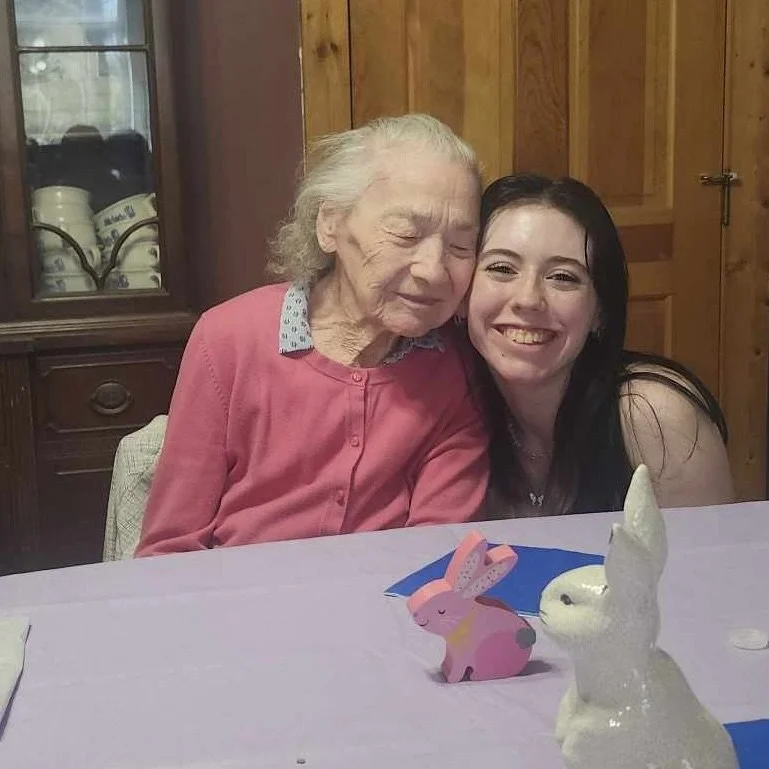
Mom and Emily: a picture worth a thousand words…
Now that my mother’s ability to endlessly repeat stories has faded away, I find myself longing for that once exasperating phase, preferable to the current precipice of total disengagement. As many other families like ours well know, it’s unnatural and painful to grieve a living person—to watch their life pass away before their body does, to accept their shrinking world and its empty hours ticking toward an overdue end. For me, this creeping loss is complicated by guilt and fear.
The guilt stems from a self-imposed judgement about abandoning my mother to pursue my dream of living abroad. I am not alone in that self-flagellation. Many of the female expats I have met or follow through social media, suffer the same internal conflict; because our mothers raised us to be independent dreamers, we are not present with them in their twilight years. In hindsight, I realize my mother may well have experienced that conflict too, having lived most of her adult life nearly 3,000 miles from her mother who also lived well into her 90’s.
The fear stems from sharing many of my mother’s physical and personality traits. My family is quick to tease that I am gradually “becoming” my mother each time I employ one of her antiquated expressions like “the wreck of the Hesperous” (a reference to a Longfellow poem loosely based on a ship that sank off the coast of New England in 1839), or when I channel her “packaging engineer” skills to maximize storage (e.g., recovering a smidge of cupboard space by cutting down an oatmeal container as the grain is depleted), or when I unearth a stranger’s life history within five minutes of meeting them. While my usual defense is that “I could do worse” than be more like my remarkable mother, watching her slow demise does feel like looking through a window onto my own potentially terrifying future. This harsh possibility leads to some unpleasant but necessary investigations into foreign elder care, financial planning, and inheritance decisions.
Despite these morbid realities, I am comforted and lifted by countless memories from the treasure trove of stories my mother has bequeathed to me. For the foreseeable future, my travel agenda will continue to prioritize Boston visits that enable me to spend weeks at a time by her side. While “the fates” allow, it will remain my honor to lovingly and patiently accompany her along this final stretch of a long and storied journey.
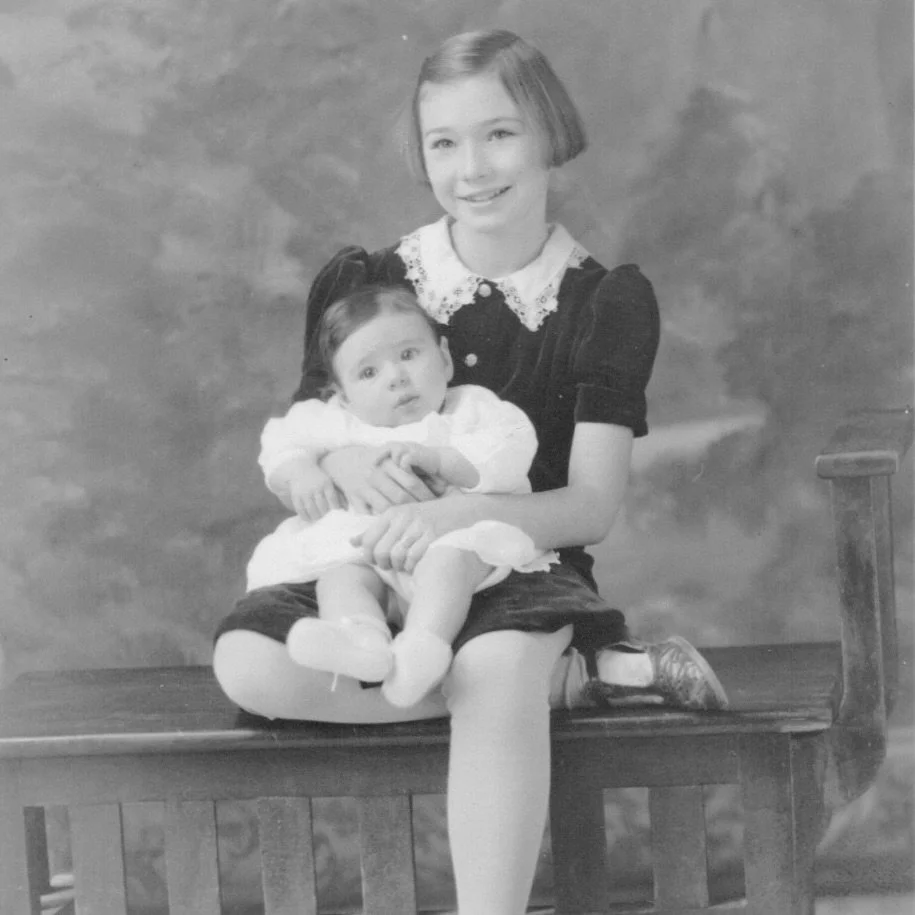
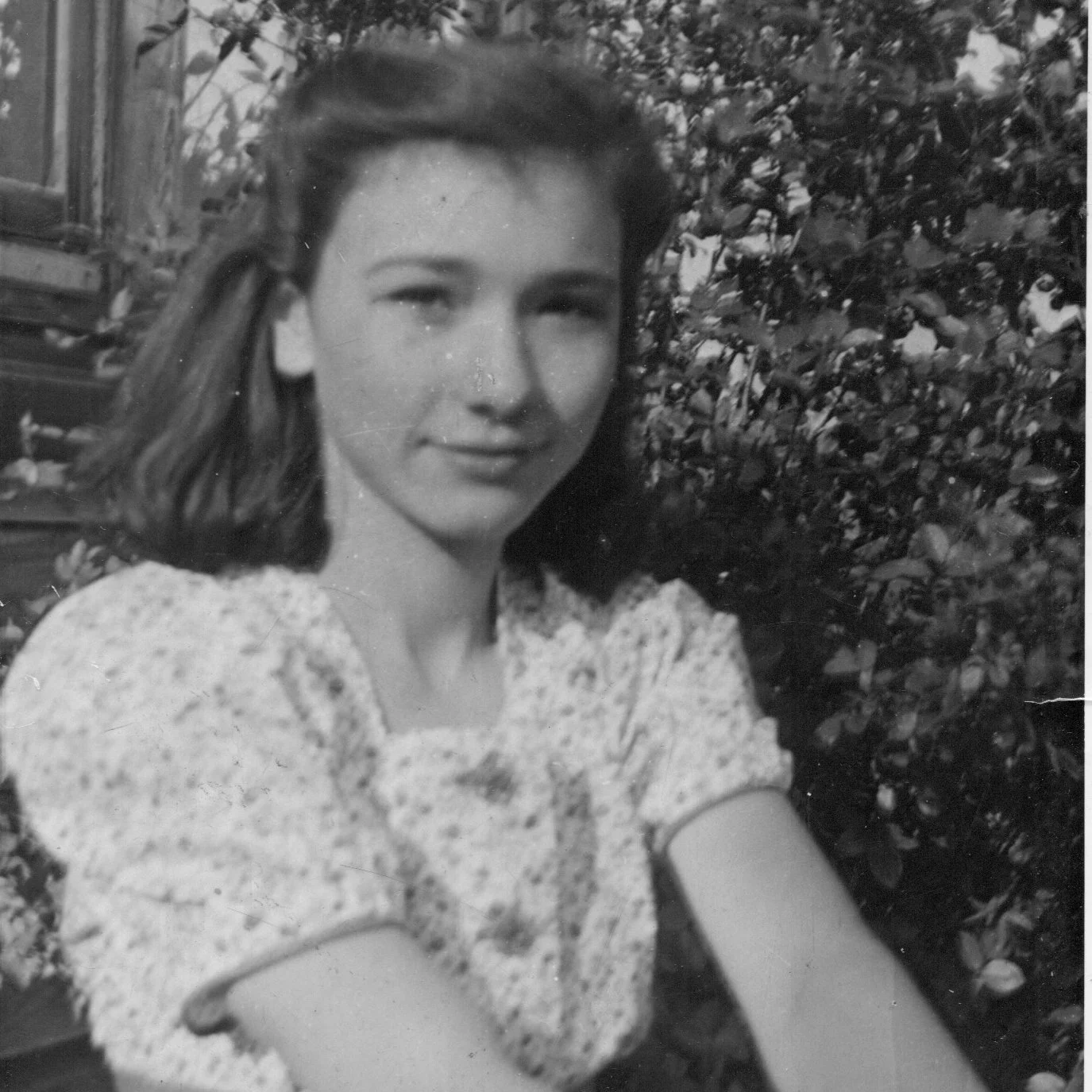
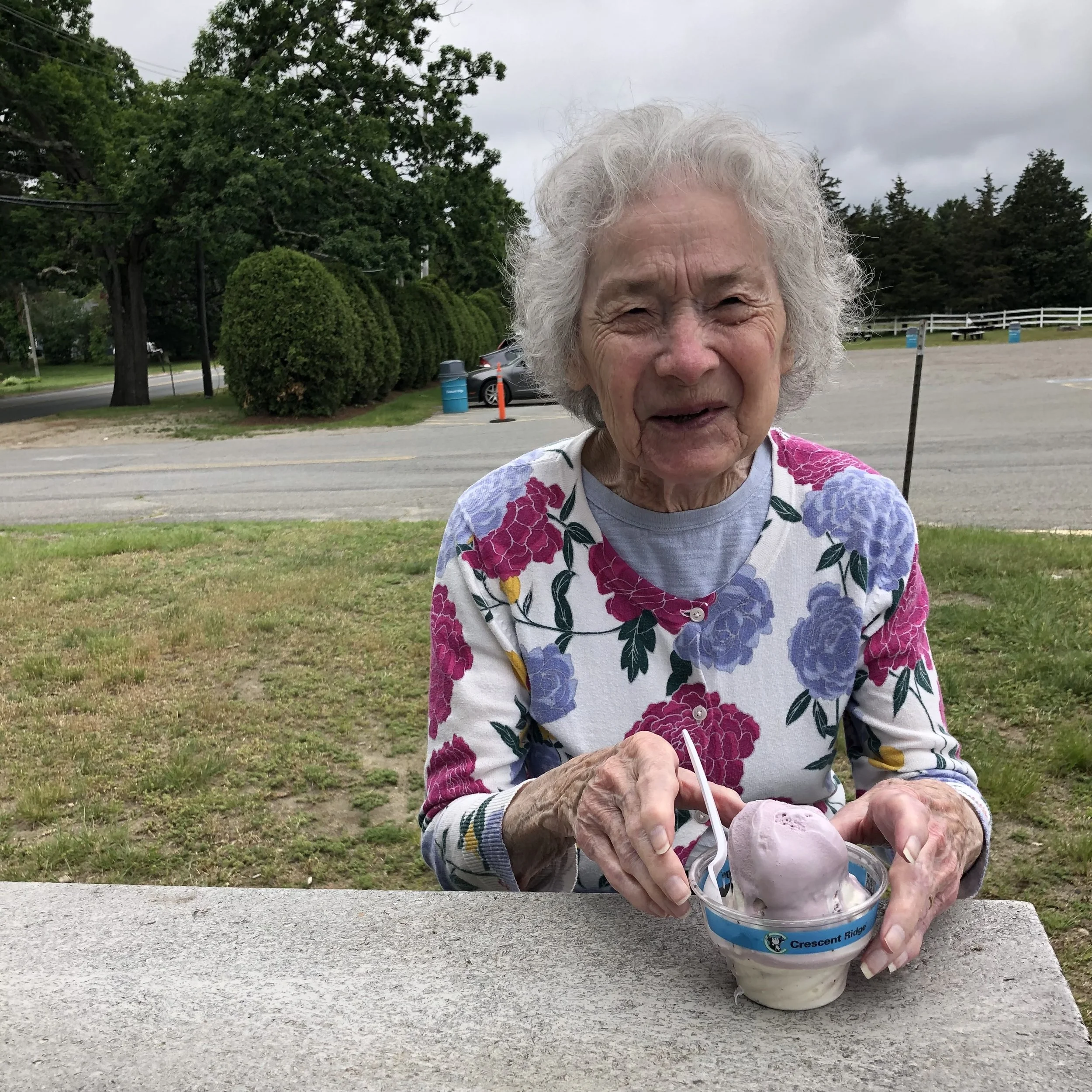
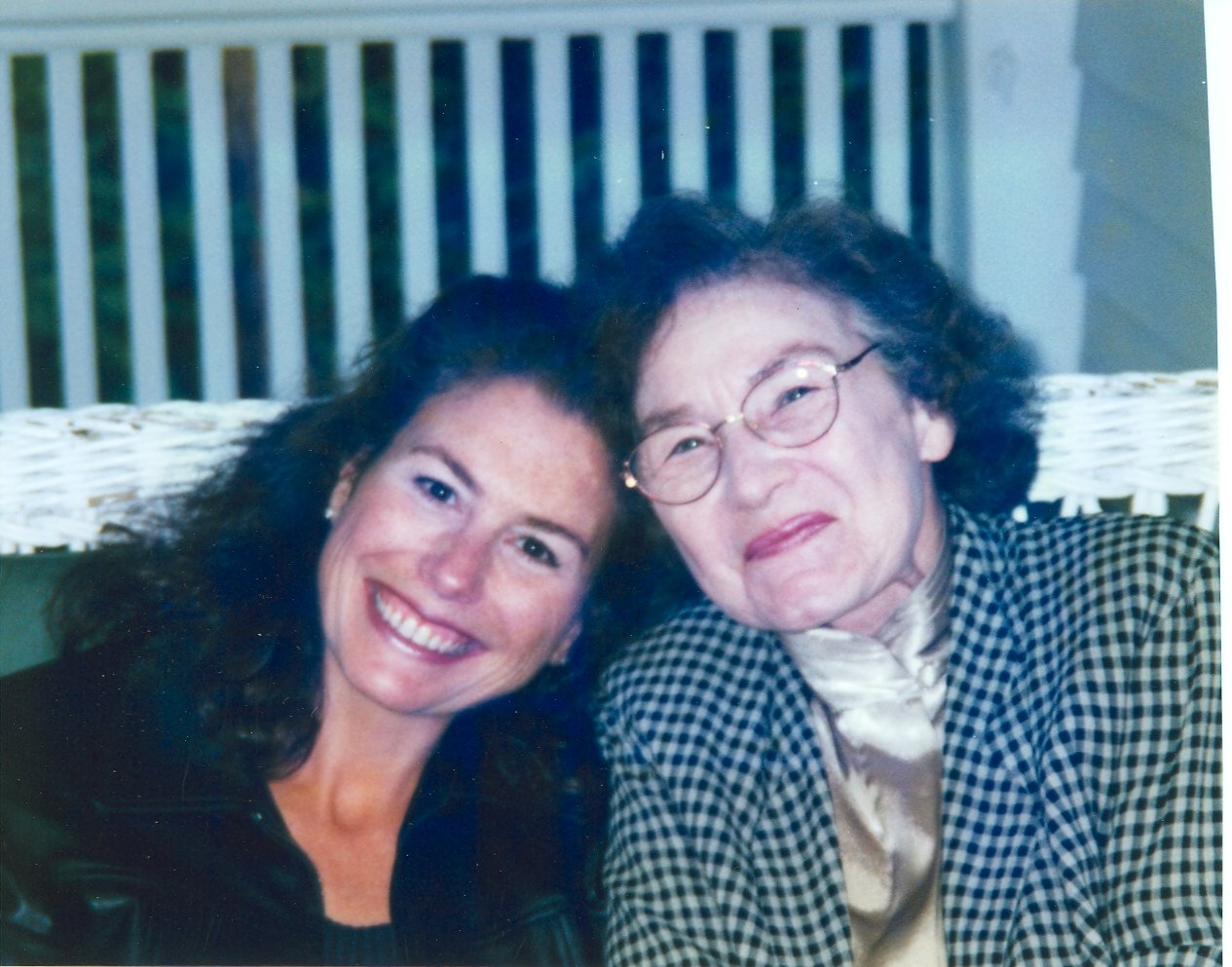
Mom and sister Davina, Mom in her early teens, indulging her favorite food group, and a favortie picture of us together.