The Art of the Possible
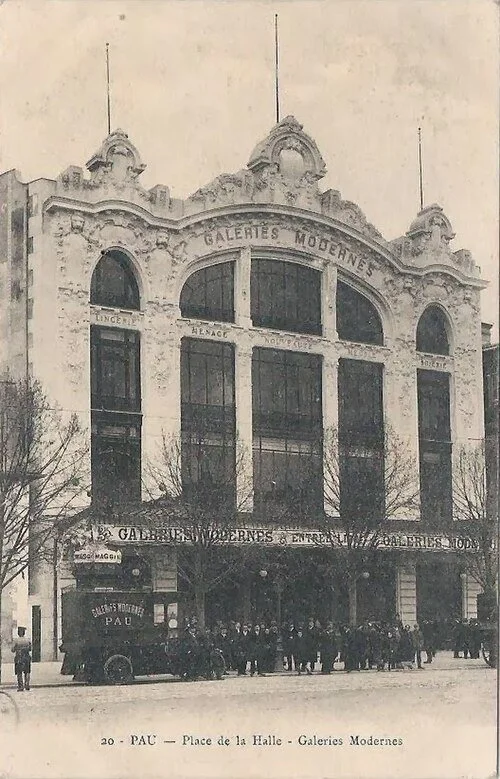
Galeries Lafayette in 1903.
Rising from the ashes…
I had just returned to Pau from my fall trip to Boston and decided to take a morning walk through the city center. Every neighborhood was buzzing with rejuvenation: restoring private buildings, maintaining roads, planting and replenishing green spaces, and forging ahead on public works. Much to my surprise, renewal of the main public square, Place Clemenceau, had expanded across the street to include the city’s former retail cornerstone, the “Galeries Lafayette,” part of the iconic, Parisian department store chain. The interior of the building was ravaged by fire in 2016 and has remained a boarded-up eyesore while the property languished in a bankruptcy court battle.
Notable Pau architect Lucien Cottet designed the Art Nouveau building as a private mansion in the early 1800’s. Years later, when the family sold the property, it was converted to a hotel and in 1869, it became the city’s first department store: “Nouvelles Galeries” and later “Galeries Modernes.” Over the next two centuries, the “grand dame” underwent several facelifts. An Art Deco refresh in 1929 was followed by a brutalist glass façade in the 1960’s that was fortunately removed in 1983 when it joined the “Galeries Lafayette” family. Following the fire in 2016, the neglected beauty laid dormant for five years until the courts finally allowed the City of Pau to purchase her. (1)
“Et voila!”: Madame lives to see another century and another visage. By the end of 2027, she will be a bustling center of commerce once again, but for the first time, sporting a rooftop restaurant. She will overlook Place Clemenceau’s elegantly redesigned reflecting pool, graced with the original art nouveau fountain figure of a reclining woman.


Above: Place Clemenceau—fountain before renovation and photo rendiering of new fountain pool. For a short video of the square’s recontruction, click link. https://www.youtube.com/watch?v=BZofK_nDpuA
Waxing poetic…
Why do I wax poetic about her trials and tribulations? For me, her story represents Pau’s commitment to preserve its rich history and natural beauty, while investing in the future quality of life for its citizens. In fact, the city’s motto, “Pau Capitale Humaine” is emblazoned on the side of every public works vehicle as a constant reminder of its communal philosophy. The ubiquitous motto references an 1866 quote by Victor Duruy, the country’s first National Minister of Instruction, who initiated extensive and controversial educational reforms, including secondary education for girls. (2) Duruy eloquently claimed that “developing human potential is capital, and the most precious of all." (3)
From the city government’s perspective, all of Pau’s attributes must service its human potential. In its online newsletter, the city asserts that “Pau offers all the advantages of a capital city on a human scale, with an exceptional quality of life close to nature: high-quality infrastructure and services, a dynamic business community, and a formidable human capital, a reservoir of talent and skills.” (4)


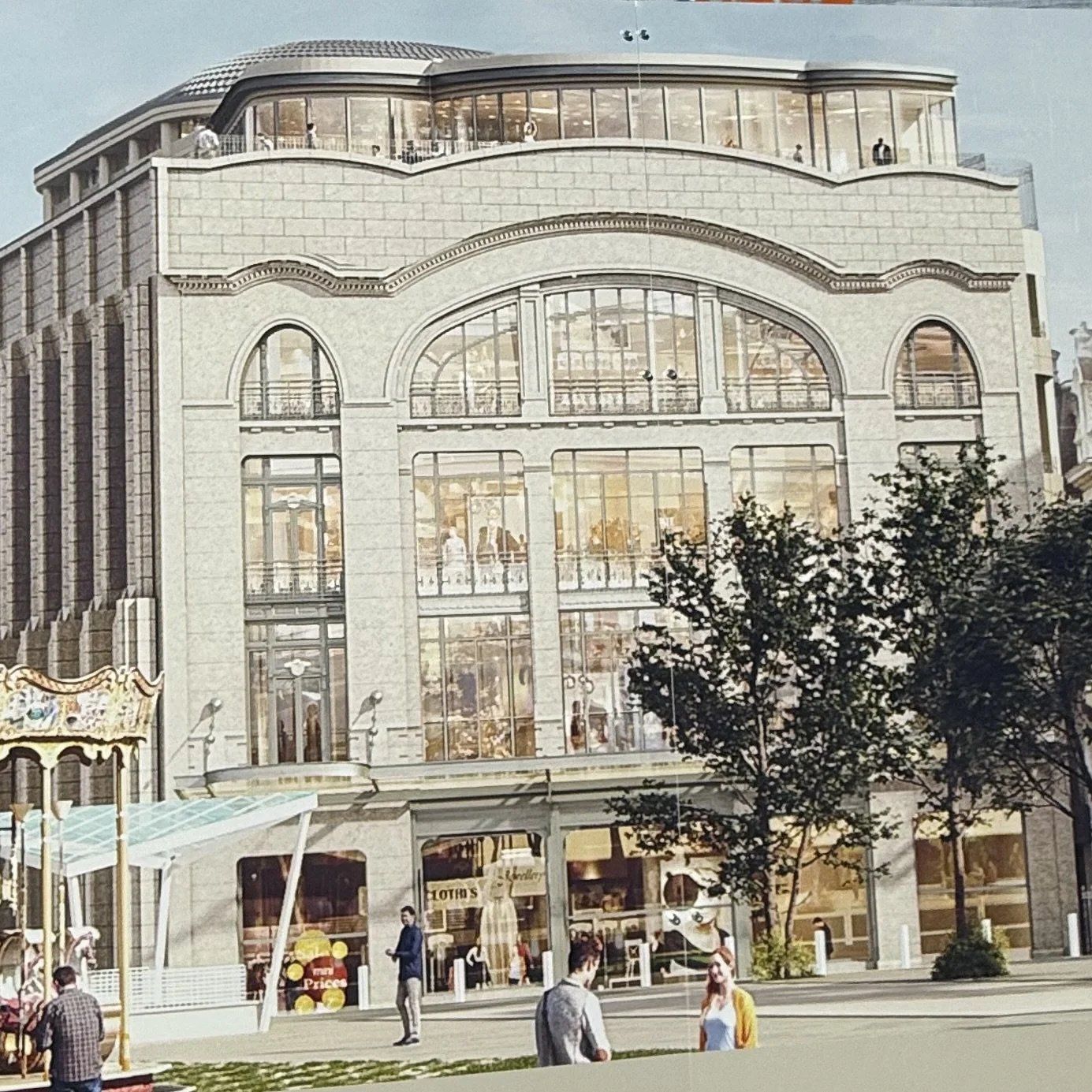
Above: Galeries Lafayette 1960’s facade, 2020’s image before the fire, current reconstruction, rendering of future look with rooftop restaurant.
Imagining the impossible…
I couldn’t agree more. But how does an ancient city, whose land has been occupied since the Gallo-Roman era, thrive in the modern world without losing the history and way of life that makes it so appealing? Pau’s answer to the conundrum was to create a “digital twin.” In 2019, the city acquired a ground-breaking 3D mesh model of the main city and its agglomeration (county), covering the entire 388.5 square kilometer area (150 square miles). “It is probably one of the most advanced depictions of an innovative approach to capture and deliver a multi-scale 3D reality model…to deliver a fully immersive and interactive experience from the sky to the ground.” (5)
The masterminds of two Australian companies brought this “digital twin” to life. Geospatial tech company Aeometrex ‘s French partner IGO created the 3D model using the latest digital technology from Bently Software. The true magic of the “digital twin,” according to Dorothea Manou of Bently Software is that it “allowed residents to explore, interact, and see—all in 3D—exactly how the skyline project integrated into the landscape without affecting Pau’s scenic skyline in any way.” Manou believes “Pau’s story demonstrates the art of the possible.” (6)
The “digital twin” has enabled Pau to achieve aggressive urban development while protecting its precious resources: the historic royal district, the view of the mountains from the Boulevard des Pyrènees (safeguarded by national decree), the “Rives des Gaves” (Pau’s river system), and the quality of life for its citizens. Since its implementation, the 3D model has been used for “town planning, transportation and traffic, risk management, and urban logistics”. (7)
Sitting ringside…
We have been fortunate to sit ringside at this spectacular show of possibility; witnessing countless metamorphoses. An old, diverted tributary of the Gave de Pau has been transformed from a dried-up riverbed, used primarily as a “doggie toilet,” into a vibrant row of restaurants, a playground, and an archeological dig revealing Roman baths.
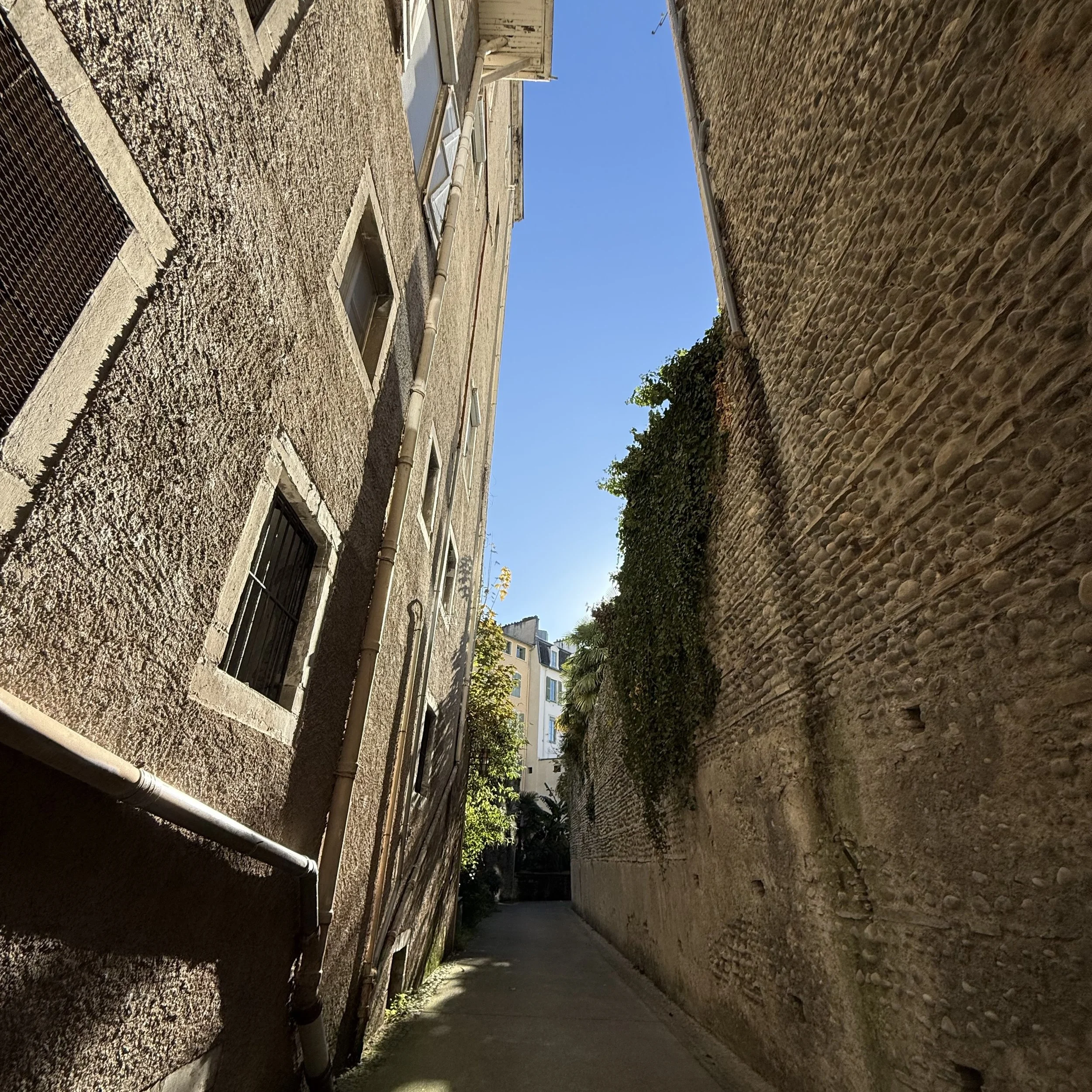


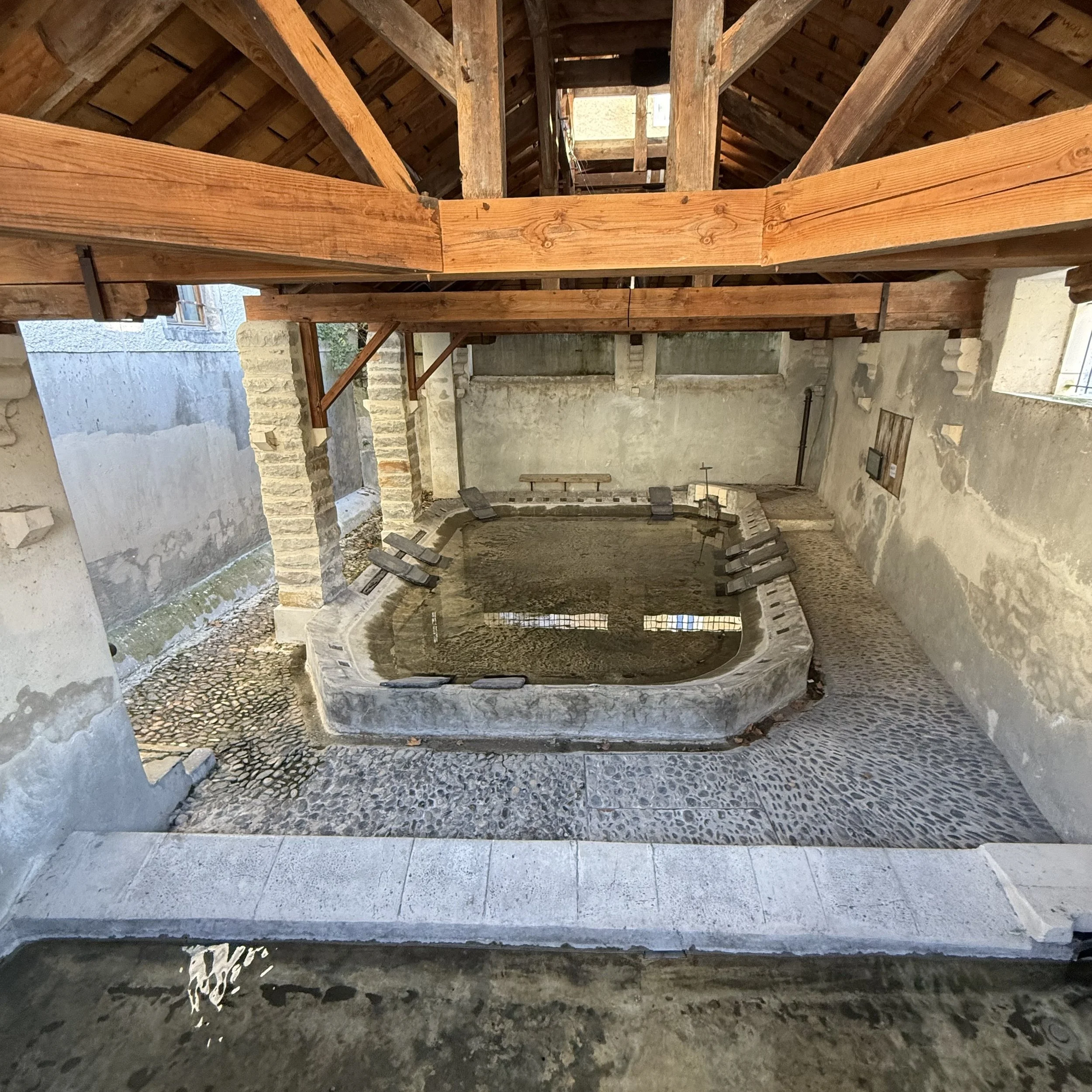
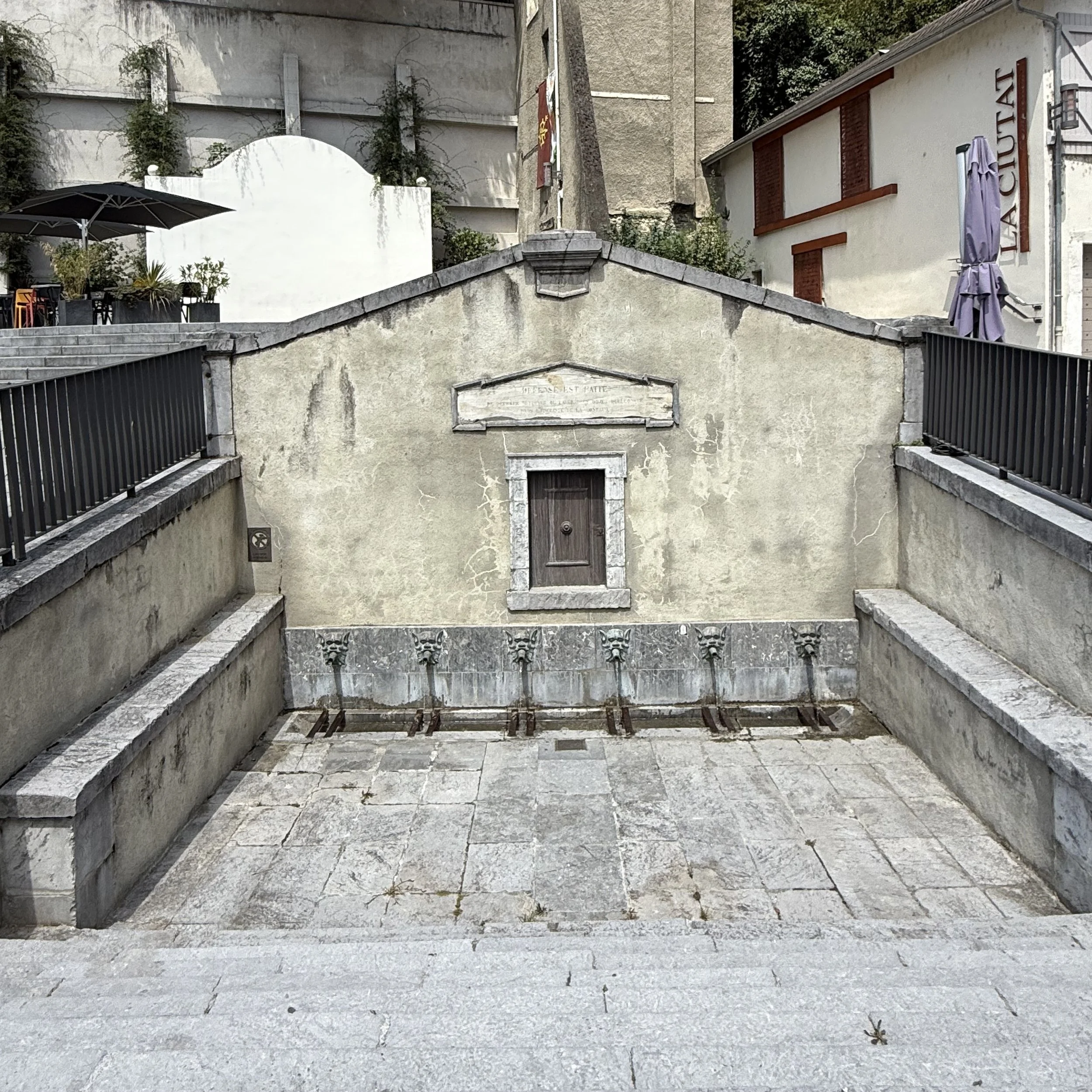

Slideshow Above: Rue du Hedas: recovered river bed below the level of the city center.
The old dark, musty market hall has been replaced with a light-filled, modern glass and chrome complex that houses all the old vendors and many new ones plus community spaces for concerts, holiday events, and public meetings. Humdrum public housing has been lifted with colorful and creative architectural facades and revitalized outdoor spaces.


Slideshow Above: Les Halles markets (exterior and interior) and new facades for social housing.
Streets have been narrowed or diverted to expand historic squares and sidewalks, shifting priority to pedestrians and cyclists. This has increased outdoor seating at many cafés and discourages dependence on automobiles. Decades of grime have been sandblasted off the surfaces of historic buildings to reveal the beauty of granite, river rock, and creamy colored render. The amphitheater in Parc Beaumont, one of the only art deco stone amphitheaters in France, was refurbished and is now home to free summer entertainment.


Slideshow Above: Art Deco ampitheater and restored facades on historic buildings.
Pondering Boston…
Now when I visit Boston, a city I love and my home for over thirty years, I wish it had a “digital twin.” Like Pau, it has a human scale, natural beauty, economic strength, and a rich history. But I have often witnessed missed opportunities and broken promises from those in charge of its growth and preservation.
In 1987, I was a young newlywed, living in Boston’s South End; my first urban living experience. I vividly remember my initial excitement when the city demolished the deteriorating, smelly, and crime riddled elevated section of the Orange Line, the branch of the transit system that I commuted on daily. I had looked forward to the new “Silverline” light rail transit that was promised to replace it, but that never came to fruition. Instead, we got four bus links and a swath of barren asphalt. Was this the best Boston could do along the route where General George Washington famously rode his “prized steed” to commemorate the city’s critical role in the war for independence? (8)
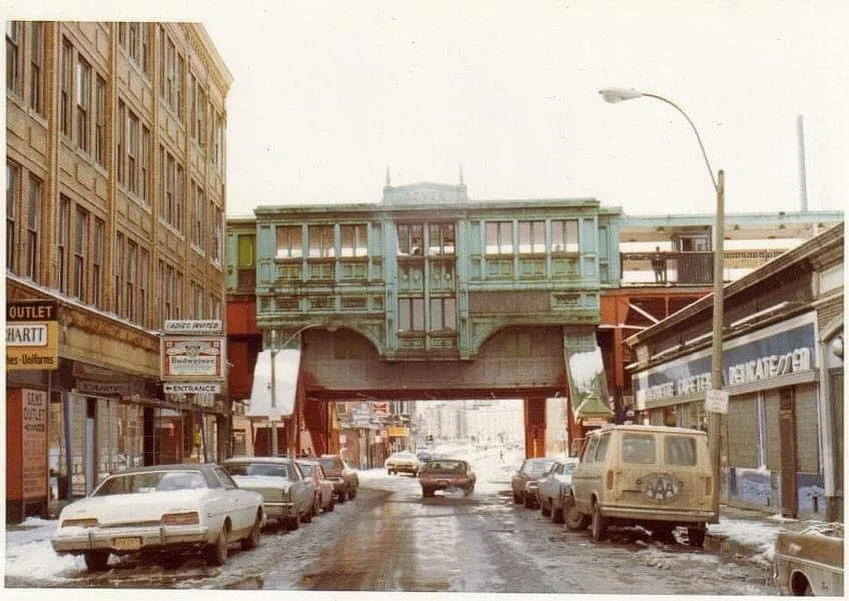
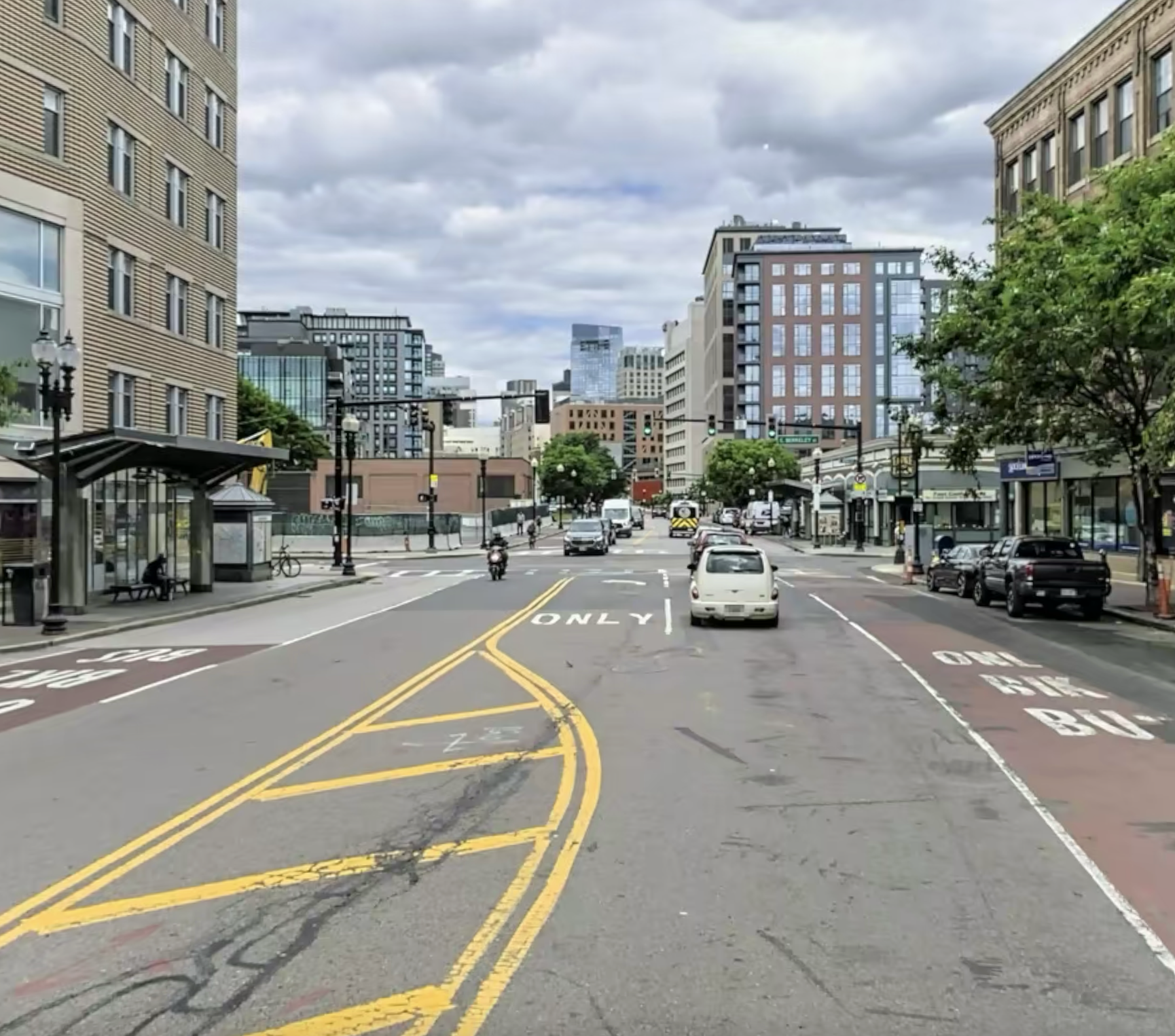
Above: Old Dover Street Station (now East Berkley Street) and current intersection of Washington and East Berkley Streets.
Perhaps the biggest missed opportunity I witnessed in Boston was the redevelopment of the Seaport District. Originally, this South Boston waterfront was a maritime, industrial zone comprised largely of historic wharfs, fish processing plants, and warehouses. The 23-acre area of largely defunct businesses and abandoned buildings, was a rare opportunity to create an entirely new neighborhood, especially one unbound by many of the historic preservation restrictions experienced in the city’s other historic neighborhoods.
The district was poised to welcome adventurous and inspiring new architecture that could both serve the economy and connect residents to the harbor and new green spaces. Sadly, the first wave of new buildings were unimaginative interpretations of Boston’s historic red brick counterparts. The next wave of predominately glass and steel structures were largely quick-to-build rectangles except for the massive, sweeping curved curtain walls of the “10 World Trade building” or the pleated fan of glass “sails” on the “Saint Regis Residences”.
Unfortunately, the density of development leaves little green space and much of the district is disconnected from its prized port in a maze of high-rise canyons. Welcoming many chain stores and restaurants at the cost of losing local gems like the “No Name Restaurant” and the “Society of Arts and Crafts” (one of the country’s oldest arts and crafts nonprofit organizations) contributes to the neighborhood’s lack of soul.
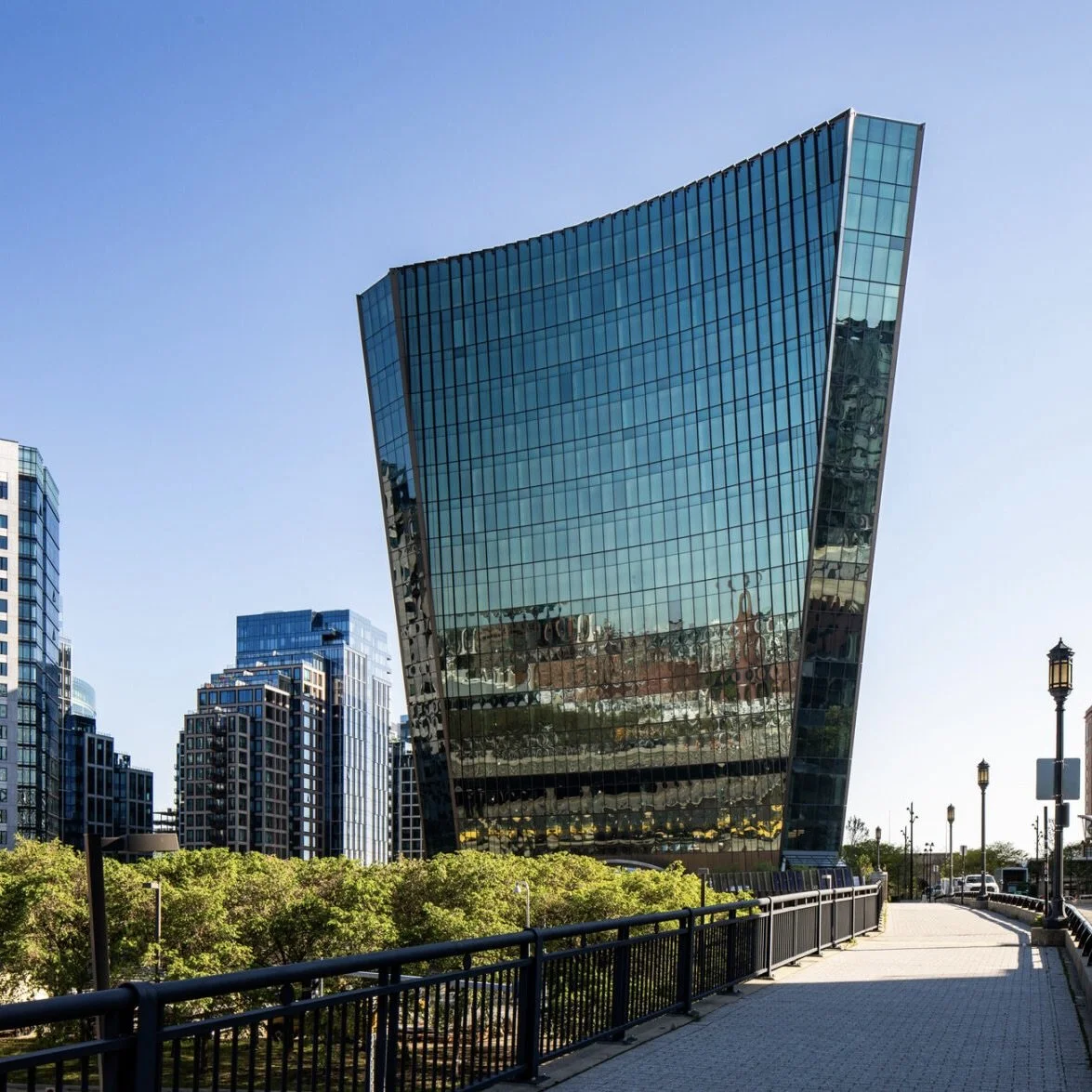
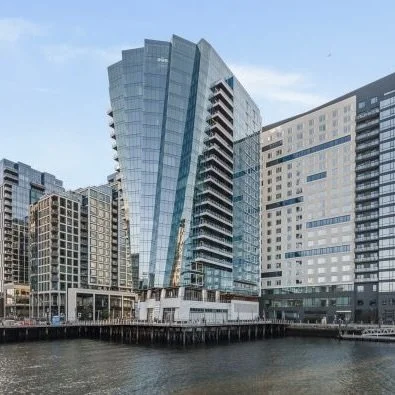
Above: “10 World Trade building,” architects Sasaki Associates Inc.; “Saint Regis Residences,” Elkus Manfredi Architects.
Reckoning Boston…
Is the problem simply one of culture? Bostonians, and New Englanders in general, are often characterized as puritanical, stoic, frugal, hardworking, proud traditionalists. This may not seem like the most fertile ground for creativity and risk taking, but let’s not forget that its citizens once held a “tea party” that launched a revolution. It has also been home to an abundance of leaders, intellectuals, creatives, and risk takers: from Wampanoag chief King Philip, Benjamin Franklin, Thomas Jefferson, Samuel Adams, Paul Revere, Emerson, Longfellow, Alcott, Frost, Winslow Homer, Melnea Cass, Booker T. Washington, Harriet Tubman, JFK & RFK, Mel King, Leonard Bernstein, to Julia Childs and Donna Summers. Just to name a few of the top 100…
My perspective aligns with that of journalist Rachel Slade who in 2020 pinned the burden of the city’s planning and development problems squarely on the Boston Planning & Development Agency (BPDA) and has repeatedly called for the agency to be abolished. She recounts the BPDA’s long and storied history of inefficiency and corruption, and delivers a searing indictment of Boston’s urban planning in the hands of this agency: “the city’s entire development process, from zoning to planning to project approval, is controlled by this single agency on the ninth floor of City Hall. In fact, it holds a concentration of power not seen in any other American city, shaping every square inch of our town, yet it is not accountable to the elected members of the city council. Its operations, meanwhile, are plagued by shortsightedness, ineptitude, and misplaced priorities.” Slade attributes much of this to the fact that the BPDA’s funding largely came from fees charged to real estate developers, rather than from a city budget with oversight. (9)
Reforming Boston…
Considering this unfortunate history, it may seem like the “ship has already sailed” on Boston’s opportunity to forge new possibilities, but there is hope on the horizon. The current Mayor, Michelle Wu, has made one giant step in the right direction. In 2024, she established a Planning Department within the city government, separate from the BPDA, thereby including it in the city’s budget. (10) While this shift in fiscal control is a great start, the more difficult task will be to change Boston’s long-standing culture of “build-more, build-fast,” a mindset that has enabled a handful of developers, armed with big budgets and powerful lawyers, to repeatedly blindside neighborhood organizations and obstruct community participation in projects directly impacting them. (11)
Boston could learn two important lessons from Pau’s “digital twin” success. The first is that a city’s greatest asset is its human capital, not its capital profit. The second is that community participation in urban development is not a nuisance but rather an invaluable tool for designing and implementing a successful plan. Perhaps the art of the possible that Pau has unlocked and Boston has not, is to tap into its richest resource: the voices of the city’s intellectuals, community leaders, creatives, risk takers, and everyday citizens. I hope all of Boston’s “powers-that-be” are listening.
To experience the city of Pau using its ground breaking, 3D Mesh Model, click the link below:
To experience Boston’s admittedly less impressive 3D model, lacking Pau’s “mesh” technoloygy to bring it to life, click the link below:
http://www.bostonplans.org/3d-data-maps/3d-smart-model/citywide-3d-model
FOOTNOTES:
(1) Translated from fr.Wikepedia.org https://fr.wikipedia.org/wiki/Galeries_Lafayette_(Pau)
(2) Encyclopedia Britanica https://www.britannica.com/biography/Victor-Duruy
(3) Translated from fr.Wikepedia.org https://fr.wikipedia.org/wiki/Capital_humain
(4) “Les Idées Mèntent Le Monde.” (“Ideas rule the World”). “Pau Rencontres Littêraires” 2019 edition http://www.lesideesmenentlemonde.fr/790-pau-capitale-du-bearn.htm
(5) XYHT Magazine (no individual author credit provided), September 2025 “Twinning Pau: Multi-Platform 3D for a Royal City” https://www.xyht.com/civiltransportation/multi-platform-3d-for-a-royal-city-pau/
(6) Manou, Dorothea. (Solutions Manager Cities and Urban Infrastructure for Bentley Systems.) “A View of the Future: Visiting Pau, the French City with a Digital Twin That’s Showing the World What’s Possible.” Bentley Software Stories. June 25,2025. https://blog.bentley.com/insights/a-view-of-the-future-visiting-pau-the-french-city-with-a-digital-twin-thats-showing-the-world-whats-possible/
(7) XYHT, ibid.
(8) The George Washington Library at Mount Vernon website. Article: “New England Tour.”
(9) Slade, Rachel. “The BPDA: Paved and Confused.” Boston Magazine, 4/10/2020
(10) Michelle Wu. City of Boston Website/City of Boston Planning Department/History https://www.bostonplans.org/about-us/history
(11) Slade, ibid.